
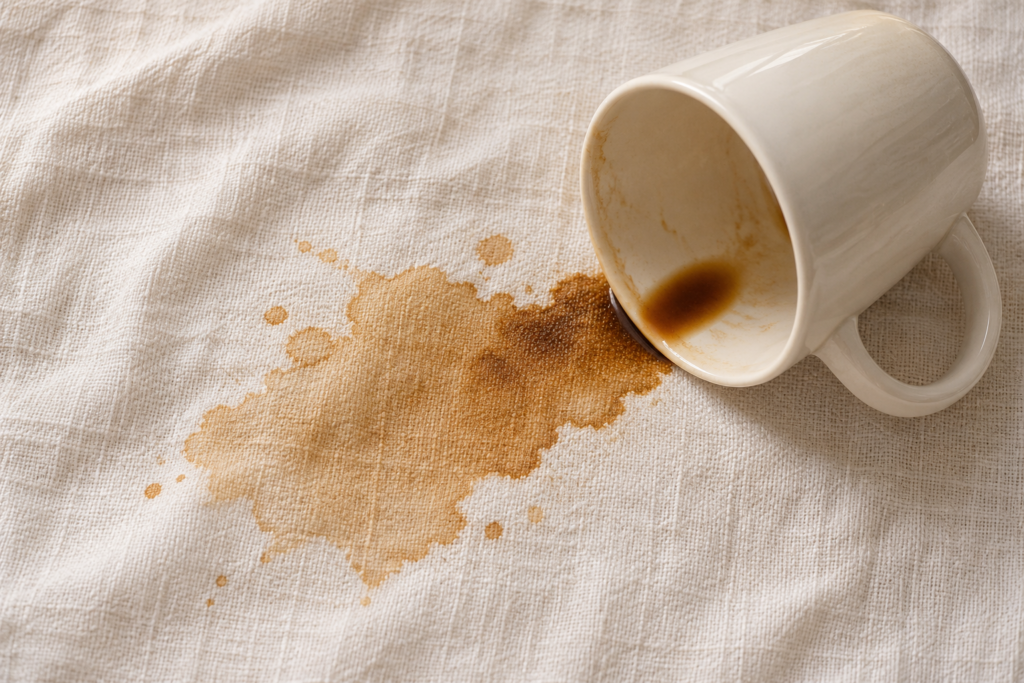
Featured image: illustrative coffee spill, not a cleaning test or before-and-after result.
Hydrogen peroxide can make some stains fade by changing the molecules that give them color. That is oxidation. It is not the same as lifting every bit of spilled food or drink out of fabric. A lighter mark does not, by itself, prove that all the residue is gone.
The American Chemical Society’s explanation of bleaching makes this distinction: stain treatment can involve removing color rather than completely removing the material behind it.
Understanding that difference helps explain why a stain remover may contain more than one kind of cleaning ingredient. It also helps you read a claim such as “lifts stains” more carefully.
How oxidation changes stain color
A colored mark looks the way it does because molecules in it absorb certain wavelengths of light. Change their structure, and you can change which light they absorb. A mark may then look paler or lose its visible color.
Hydrogen peroxide can act as an oxidizer. In simple terms, oxidation involves a loss of electrons. In bleaching, this chemistry can alter parts of a colored molecule. The useful idea is a change in structure, not a tiny brush scrubbing the stain away. See the ACS bleaching overview for the chemistry behind that explanation.
This does not mean every stain responds in the same way. “Stain” describes what you see, not one chemical with one predictable reaction.
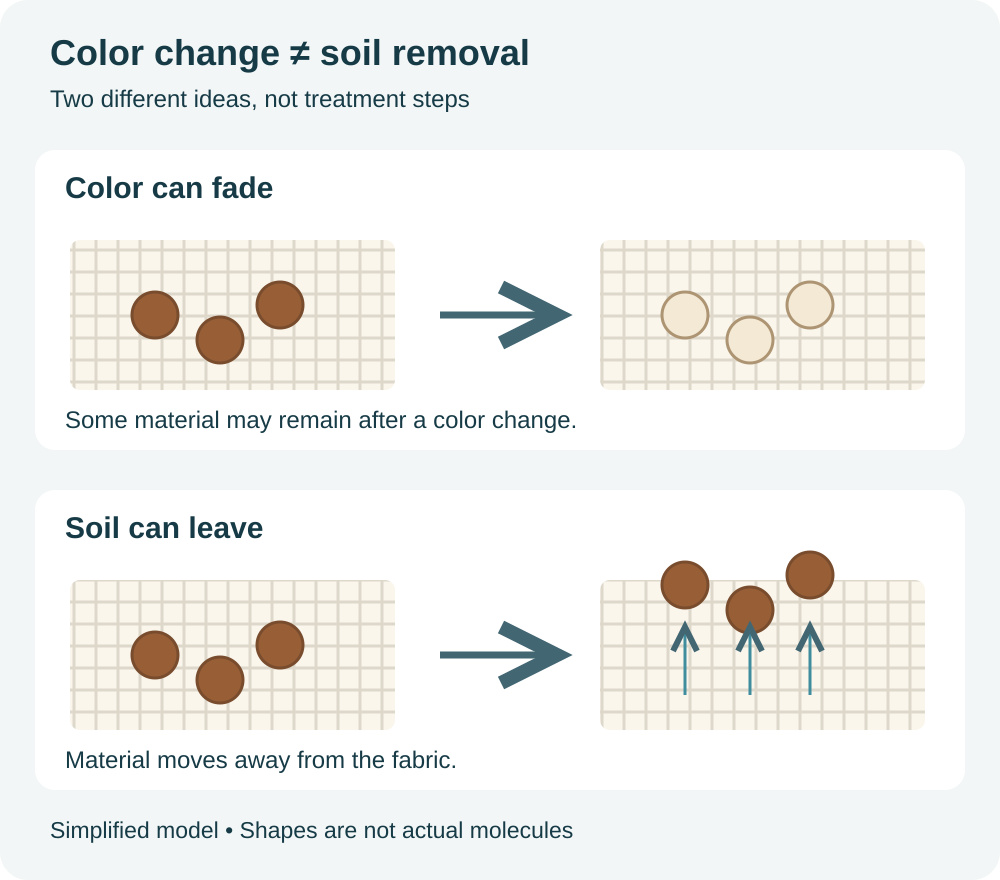
Changing color and removing soil are different jobs
A cleaning product can do several jobs at once. The ingredient list helps explain which jobs it is designed to do.
| Ingredient type | Main job | What that tells you |
|---|---|---|
| Oxidizer, such as hydrogen peroxide | Can change some colored molecules through oxidation. | Fading and complete soil removal are not the same measurement. |
| Surfactant | Helps water wet a surface and carry away soil, including oily soil. | Detergent action has a separate role from bleaching. |
| Enzyme | Breaks down particular types of soil into smaller pieces. | The type of enzyme matters; one enzyme does not handle every stain. |
A surfactant has a water-attracting end and a water-repelling end. Surfactants can surround oily soil, helping keep it in wash water so it can be rinsed away. The American Cleaning Institute illustrates this in its guide to cleaning chemistry.
Enzymes do another job. Different enzymes act on different materials, such as protein or starch. Breaking soil into smaller pieces can make it easier for other ingredients to carry away. ACI’s ingredient guide explains these roles. A formulated product may combine ingredients; that is not a reason to mix separate cleaners yourself.
A coffee spill is more than a brown mark
Hypothetical example: imagine spilling coffee with milk and sugar on a washable cloth. This is an explanation of the problem, not a test result or treatment recipe.
- The brown color is one part of the spill.
- The added sugar is another part.
- Milk adds fat and protein to the mix.
If the brown color becomes less visible, that observation alone tells you little about how much sugar, fat or protein remains. You have observed a color change, not measured each part of the spill.
This is why “the spot looks lighter” and “the cloth has been cleaned” are different statements. Oxidation and soil removal can both contribute to cleaning, but they are not interchangeable.
What this means when choosing a stain product
Start with the item’s care instructions and the cleaner’s label. The American Cleaning Institute advises checking both in its bleach-use guidance. Even a white item is not automatically suitable for bleaching.
Then ask three practical questions:
- What spilled? A drink with milk, a greasy sauce and a plain colored drink are different cleaning problems.
- What job does the product claim to do? Look for its stated stain uses and directions, rather than assuming the word “peroxide” means it is a complete detergent.
- Is it intended for this item? Cleaning chemistry does not establish compatibility with a dye, finish or fiber.
For that material decision, use our surface-first stain guide. For clothing, our laundry compatibility guide covers the label limits.
The takeaway: hydrogen peroxide can change stain color. A suitable cleaning process also has to deal with the rest of the soil and protect the item. Judge the whole job, not just the fading.
