
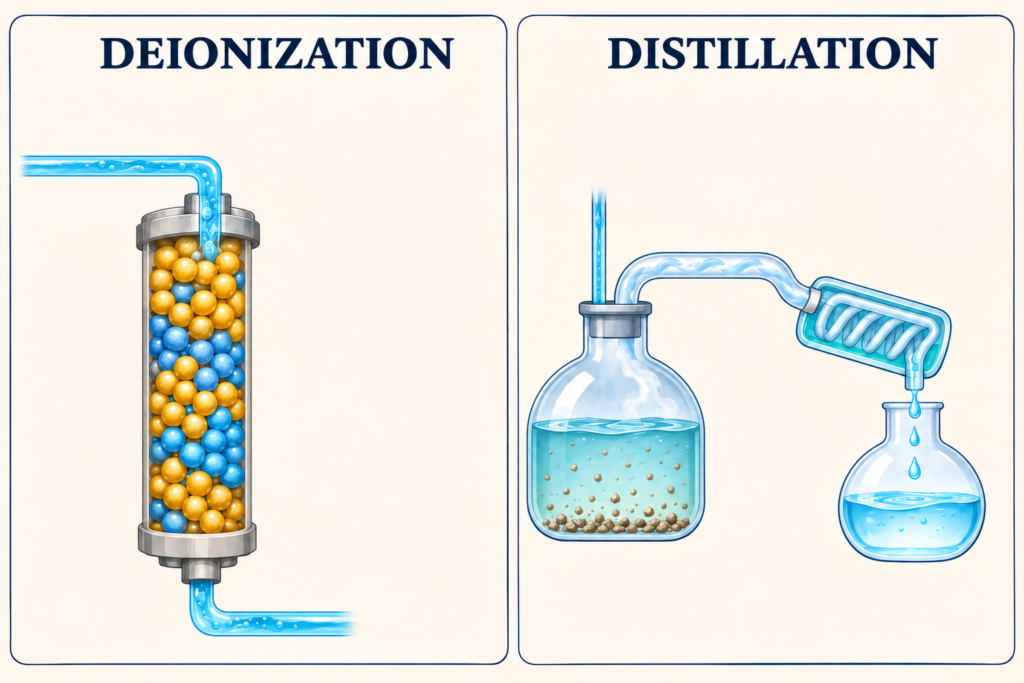
Deionized water and distilled water are made by different processes. Deionization removes dissolved ions using ion-exchange materials. Distillation separates water by evaporation and condensation. Both can reduce mineral content, but neither name tells you every quality characteristic of the water in a particular bottle.
For a buyer, the useful question is which water meets the job’s requirements. If you have ever wondered why one bottle can say both “deionized” and “distilled,” the answer is that the water can go through both processes. What matters next is the specification for your use.
Deionized vs. distilled water at a glance
| Question | Deionized water | Distilled water |
|---|---|---|
| Process | Ion exchange removes dissolved charged substances. | Water is evaporated, then the vapor is condensed and collected. |
| Main target | Ions such as calcium, sodium and chloride are exchanged at the resin. | Many nonvolatile impurities stay behind rather than traveling with the water vapor. |
| Limitations | Ion exchange alone does not effectively remove every organic substance, particle or microorganism. | Some volatile contaminants can carry over. The system design and any other treatment steps matter. |
| Grade assured? | No. Check the product’s stated quality limits. | No. Check the product’s stated quality limits. |
| Used together? | Yes. They describe different treatment steps, so they are not mutually exclusive. | |
The process distinctions are described in ELGA’s ion-exchange overview and Thermo Scientific’s water-purification guide. The table compares methods, not test results for a particular product.
What happens during deionization?
Ordinary source water contains dissolved substances with positive or negative electrical charges. These are ions. Calcium and sodium are examples of positive ions; chloride is a negative ion.
In conventional deionization, water passes through resin beads. One type exchanges positive impurity ions for hydrogen ions. Another exchanges negative impurity ions for hydroxide ions. The released hydrogen and hydroxide combine to form water. A mixed-bed system brings both resin types together.
This is different from straining particles through a screen. Ion exchange works on dissolved charged substances. A treatment system may include other stages to address other contaminants. ELGA, for example, describes using ion exchange with reverse osmosis, ultraviolet treatment and filtration in its laboratory systems. Those additional steps should not be assumed from the letters “DI” alone. See ELGA’s explanation of ion exchange.
What happens during distillation?
Distillation uses a change of state. Water becomes vapor, and that vapor is cooled back into liquid water for collection. Many dissolved mineral salts and other nonvolatile materials remain behind.
The vapor is the important part of the separation. Boiling water and leaving it in the original vessel does not produce collected distilled water.
Distillation also has limits. Thermo Scientific explains that gases and some low-molecular-weight organic substances are not effectively removed by distillation alone. Equipment design and pretreatment can influence the result. “Distilled” should therefore not be read as a promise that every possible contaminant has been removed. See the guide’s Distillation 101 section.
Why can a bottle say “deionized distilled water”?
The names describe different processes, so water can undergo both. A combined description is not inherently contradictory. It also does not tell you the order of treatment, the number of passes or the final test results.
Bulk Peroxide’s Deionized Distilled Water is listed in a one-gallon size. If your application requires a particular production sequence or numerical quality limit, confirm that requirement for the product before ordering. The combined name alone does not establish an ASTM water type, a laboratory grade or sterility.
Which one is purer?
There is no reliable overall ranking based only on the two names. Purity has several parts: dissolved ions, organic contaminants, particles and microorganisms can matter in different ways.
Merck’s water-purification technology overview explains why systems combine methods. Ion exchange effectively targets ions but has limits for organics and microorganisms. Distillation can remove a broad range of contaminants, yet carryover and contamination during storage can affect the collected water.
That makes “Which is purer?” an incomplete buying question. “Which product meets the limits for my use?” is more useful. Two bottles with different process names may both meet a given requirement. Two bottles with the same process name may have different specifications.
Three situations that change the buying decision
Your instructions name a particular type of water
If an equipment manual calls for distilled water, follow that instruction. Do not substitute DI water merely because a comparison article says both have low mineral content. If the manual permits either, use that flexibility while meeting any additional limits it gives.
Your process specifies a measurement
A requirement may name a maximum conductivity or minimum resistivity rather than a production method. Compare the supplier’s documented result with that requirement, including its units and reference temperature.
Conductivity and resistivity describe the water’s electrical behavior and are useful for assessing ionic contamination. They do not supply a complete picture of organic contamination. Merck discusses separate conductivity/resistivity and total organic carbon monitoring in its water-quality monitoring guide.
You are replacing a previously approved water supply
Start with the old specification or the written process requirement, rather than matching a word on the front label. Compare the same properties in the new product’s documentation. If a required property is missing, ask about it before making the substitution.
For peroxide-related work, water selection is one part of a qualified process. This comparison is not a method for preparing or adjusting a concentrated peroxide solution. Our concentration and precautions guide explains that distinction.
Storage can change the comparison
The water leaving a purification system and the water later used from a container may not have identical quality. Air exposure, the container and handling can introduce contaminants. Merck identifies both surrounding air and storage materials as possible sources of recontamination. See its discussion of storage limitations.
Use the supplier’s storage and handling instructions for the exact water product. Where a process requires a verified quality at the point of use, an original process name cannot replace that verification. There is no universal opened-container shelf life established by “DI” or “distilled.”
Common questions
Is demineralized water the same as deionized water?
The terms are often used together, but “demineralized” is broader: it describes removal of mineral content without necessarily identifying the method. ELGA’s Pure LabWater Guide distinguishes water definitions and purification processes. Check how the supplier uses the term.
Is softened water a substitute for DI water?
Not on the basis of softening alone. A conventional sodium-ion softener exchanges calcium and magnesium for sodium. That reduces hardness but leaves dissolved ions in the water. Merck explains the difference between softening and deionization.
Does distilled mean sterile?
Do not infer the sterility of a packaged product from its production name. A distillation process and the condition of the water after collection, packaging and storage are different questions. If a task specifically requires sterile water, the product must be identified and suitable for that requirement.
Choose water by the requirement, then the product
Use the process name to understand how the water was treated. Use product information and any required test results to decide whether it fits the job. If you are considering our one-gallon Deionized Distilled Water, contact Bulk Peroxide with any specific water-quality requirements before ordering.
