
Hydrogen peroxide can discolor some nylon garments, and the word “nylon” on the tag does not tell you whether bleach is allowed. Skip peroxide if the care label says “do not bleach.” If it allows non-chlorine bleach, use only a laundry product whose directions cover your item. Don’t substitute plain peroxide as a spot treatment.
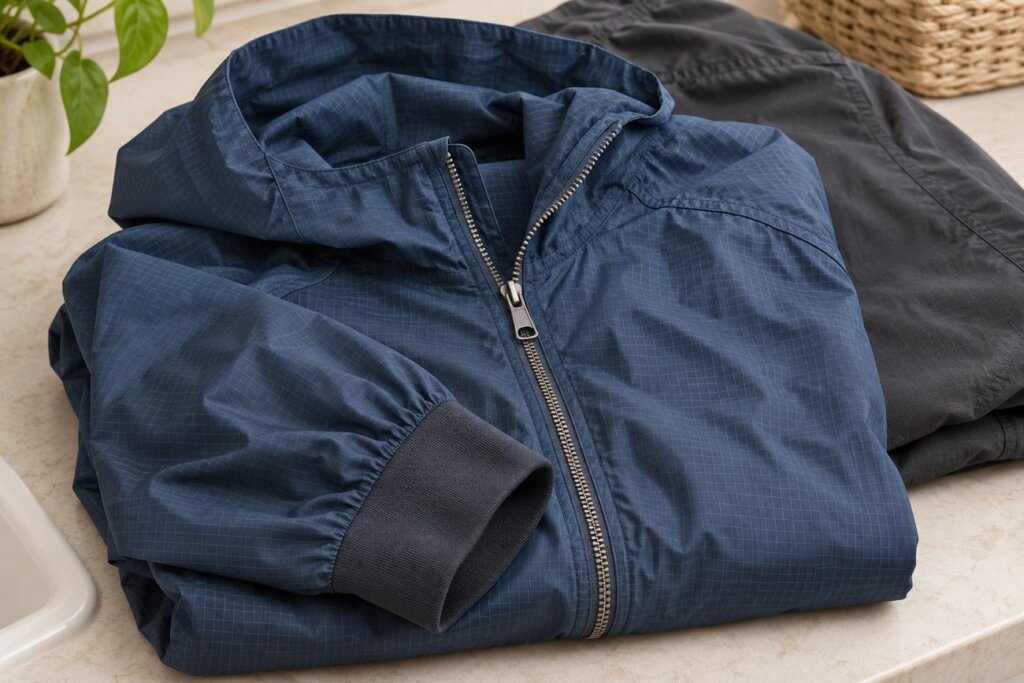
Featured image: A nylon windbreaker illustration, not a cleaning test.
Read the care tag, not just the fiber tag
The fiber tag tells you what the fabric is made of. The care tag tells you how to wash the finished item. A nylon jacket can have a water-repellent finish, elastic cuffs, and printed trim, even if the shell says 100% nylon.
For example, Patagonia’s Men’s Houdini care instructions list a recycled nylon shell with a water-repellent finish and say not to bleach it. That is a recommendation for this specific jacket, not a rule for every nylon garment. Look up your exact model if the tag has worn off.
What “non-chlorine bleach” means for nylon clothing
Hydrogen peroxide is a bleaching ingredient. The American Cleaning Institute glossary describes a hydrogen peroxide solution as a type of liquid non-chlorine bleach. “Non-chlorine” tells you the type of bleach; it does not mean there is no bleaching action.
| Care tag | What to do |
|---|---|
| Crossed-out triangle | Skip bleach, including plain peroxide and oxygen bleach. |
| Triangle with two diagonal lines | Only non-chlorine bleach when needed. Pick a laundry product labeled for the garment, and follow its directions. |
| Plain triangle | The label allows bleach when needed. Follow the laundry product’s instructions rather than pouring plain peroxide onto a spot. |
| Tag missing or unclear | Find the manufacturer’s care instructions for your exact garment. Skip bleach while you check. |
The ASTM care-symbol chart hosted by the FTC explains the triangles. The FTC’s care-label rule distinguishes ordinary washing from spot care. Permission to wash with a certain type of bleach is not permission to dab it on undiluted.
What if you already used peroxide on the garment?
Stop applying it and don’t add a second cleaner. If the garment is washable, follow its maker’s instructions for washing and rinsing, then look at the mark once the fabric dries as directed. If the item is dry-clean-only or needs special care, tell the cleaner or manufacturer what product you used before they work on it.
A lighter spot may be a change in the dye rather than leftover dirt. The University of Idaho Extension’s stain guide notes that even a 3% peroxide solution can change some dyes. That does not tell you whether a particular spot is permanent. Avoid repeated treatments while you’re figuring out what changed. Our guide on stain color versus residue explains why a change in color doesn’t necessarily mean something washed out.
Fabric strength and color are also separate questions. Textile supplier ORCO notes that hot, high-concentration peroxide can degrade nylon in textile processing. Those factory conditions do not tell you what happened to a jacket after a single spot treatment. If it is protective gear or an item with a waterproof lining, ask the maker about the exposure rather than judging by color alone.
