
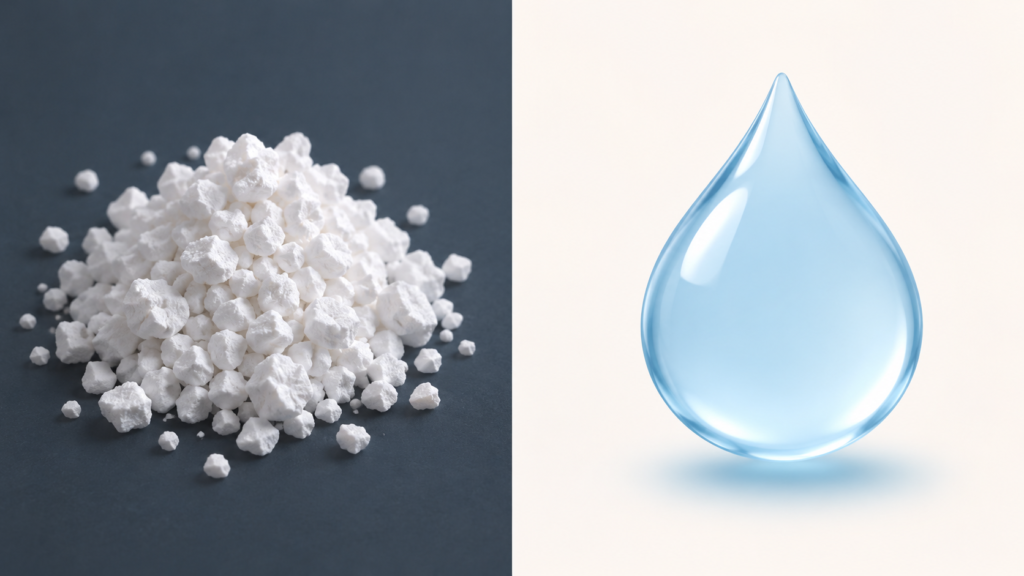
Sodium percarbonate and liquid hydrogen peroxide share peroxide chemistry, but they have different compositions. Sodium percarbonate is a solid compound containing hydrogen peroxide and sodium carbonate. Bottled hydrogen peroxide is a solution of hydrogen peroxide in water. The carbonate in the powder changes what you are buying, even before other ingredients enter the picture.
That distinction matters when a shopping list or process specification calls for a particular liquid peroxide product. A bag described as “oxygen bleach” does not automatically meet the same requirement.
The differences at a glance
| What to compare | Sodium percarbonate | Liquid hydrogen peroxide |
|---|---|---|
| Physical form | White granules or powder | A liquid solution containing hydrogen peroxide and water |
| Contents | Hydrogen peroxide combined with sodium carbonate | Hydrogen peroxide dissolved in water; check the specific grade for other ingredients |
| Carbonate | Supplies sodium carbonate as well as peroxide | Sodium carbonate is not part of the H₂O₂ molecule |
| Specs to check | Available oxygen, ingredient content and any coating or formulation details | Hydrogen peroxide concentration, its measurement basis and grade specifications |
These distinctions follow the manufacturers’ descriptions of sodium percarbonate and hydrogen peroxide in water. Neither column describes every finished cleaner sold under those ingredient names.
What the powder contributes besides peroxide
Sodium percarbonate is also called sodium carbonate peroxyhydrate. Its formula, 2Na₂CO₃·3H₂O₂, shows both parts. When it dissolves, it releases hydrogen peroxide and sodium carbonate, as described in the USDA’s technical report.
Sodium carbonate changes the chemistry: it makes the solution more alkaline, meaning it raises its pH. For example, Solvay describes its Oxyper SHC grade as a coated, stabilized percarbonate whose carbonate component raises pH and helps resist changes in pH. That description belongs to that particular grade; it is not a specification for every powder on the market.
For a buyer, the useful question is whether the intended process permits that carbonate contribution. Matching a peroxide-related ingredient name does not answer it. This is a formulation difference, not merely a choice between carrying a bag and carrying a bottle.
Why the percentages can mislead
A percentage needs a name and a measurement basis. “Hydrogen peroxide content,” “sodium percarbonate content” and “available oxygen” describe different quantities.
A useful illustration comes from Solvay’s hydrogen peroxide technical sheet: its standard 35% hydrogen peroxide solution is listed as 35% H₂O₂ by weight, with 16.5% active oxygen by weight. Those are two descriptions of the same solution, not two different strengths of bottled peroxide.
Meanwhile, the Oxyper SHC sheet specifies at least 13% available oxygen for that powder grade. Reading that as “13% hydrogen peroxide” would confuse the measurement. Comparing the largest number on two labels can therefore produce the wrong buying decision.
Ask what the percentage measures before treating two products as equivalents. These figures explain the terminology; they are not substitution quantities or preparation instructions.
A finished oxygen cleaner has its own formulation
A recognizable example is OxiClean Versatile Stain Remover Free. Church & Dwight’s ingredient disclosure lists sodium carbonate as a builder, sodium carbonate peroxide as an oxygen bleach, and a surfactant, an ingredient that helps a cleaner wet surfaces and lift soil. The finished product is therefore more than a single peroxide ingredient.
Use the exact product’s disclosure rather than assuming every “oxy” powder has that formula. For the separate question of combining products, see our guide to hydrogen peroxide and OxiClean.
Three questions before you buy
- What product does the job specify? Distinguish a finished cleaner from a raw ingredient or a specified liquid peroxide grade.
- What does its percentage measure? Check the substance named, the measurement basis and the product-specific specification.
- What else comes with it? Review carbonate, coatings and other formulation ingredients, along with the label and Safety Data Sheet.
Both concentrated liquid peroxide and sodium percarbonate require appropriate handling. A dry form does not make a product harmless. Follow the supplied safety documentation rather than inferring precautions from the packaging.
If your requirements specifically call for 35% food-grade liquid hydrogen peroxide, confirm the selected product’s concentration and grade documentation. A peroxide-containing powder is a different purchase, and the larger percentage is not automatically the better fit.
