
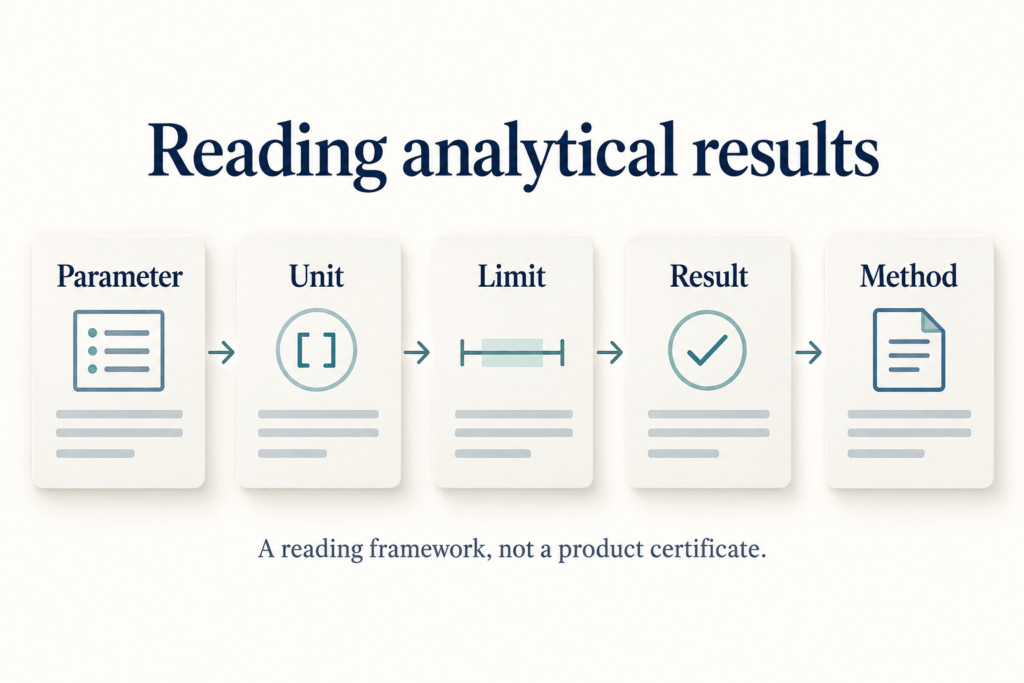
Read a hydrogen peroxide COA across the row: test, specification, result, then units. The specification tells you the requirement. The result tells you what was reported for the batch. Confusing those two columns can turn a perfectly ordinary report into a misleading one.
Consider an impurity row with a maximum of 1 mg/kg and a result of <0.1 mg/kg. The batch was reported below 0.1 mg/kg, which is below that maximum. The result is not “zero,” and the number 1 is not the measured amount. That small distinction is the key to reading the rest of the page.
Start with the four pieces of a result
| Test | Specification | Result | What it means |
|---|---|---|---|
| Hydrogen peroxide assay | 34.0–36.0% by mass | 35.1% by mass | The reported peroxide content is within this example’s range. |
| A named impurity | ≤1 mg/kg | <0.1 mg/kg | The reported upper bound is below the specified maximum; it is not an exact value. |
| Identification | Pass | Pass | The listed identification test met its criterion; this is not an assay number. |
Real reports vary. As one example, Thermo Fisher’s specification for an ACS peroxide product lists assay separately from chloride, iron and residue. Its limits apply to that product, not to Bulk Peroxide products.
Assay is the strength, not a complete purity score
Assay is the reported amount of hydrogen peroxide on the stated basis. If a solution is 35% by mass, it contains 35 grams of hydrogen peroxide in every 100 grams of total solution.
A test-strip reading is a different kind of information; its stated range and intended use matter.
The other 65 grams are not automatically “impurities.” In an aqueous peroxide solution, most of that balance is water. Separate test rows address specific impurities. Formulation ingredients, such as stabilizers, are another question; see what stabilized peroxide means.
This is why two bottles with the same strength can have different specifications. Concentration answers “how much peroxide?” Grade and the listed requirements answer different questions. Our food-grade guide explains that distinction.
The unit can change the meaning of the number
A number without its unit is only half a result. These are common ways of expressing a quantity:
- % by mass, or % w/w: grams of the named substance per 100 grams of solution.
- mg/kg: milligrams per kilogram of material. One mg/kg is one part per million by mass.
- mg/L: milligrams per liter. This is a mass-per-volume unit, not automatically the same as mg/kg.
For example, 0.0001% by mass equals 1 mg/kg. Converting a mass-per-volume result to a mass-per-mass result also requires density. NIST’s guidance on quantities and units is a useful reference for these distinctions.
Older volume-strength names are a separate convention; see what “100 volume” means.
Keep the substance name, too. A result for iron is not a result for every metal. A grouped test with wording such as “as Pb” should not be rewritten as separate measurements for each element.
What “less than” does and does not tell you
A less-than result gives a boundary, not an exact amount. The report should explain whether that boundary is a detection, quantification or reporting threshold. Those are different concepts; NIST’s discussion of detection and quantitative determination explains why.
Here is the important buying example. Suppose your requirement is no more than 0.5 mg/kg, but the COA reports <1.0 mg/kg. That does not settle your question. A value of 0.7 mg/kg would fit the reported result but exceed your requirement. The right conclusion is “we need more information,” not “pass” or “fail.”
Likewise, <0.1 and <0.05 do not tell you which of two batches actually contains less. Both might be far below either threshold. Do not rank products by treating those boundaries as measured values.
Three details to check before accepting the result
- The lot: make sure the certificate connects to the material supplied. The SDS vs. COA guide covers document matching.
- The applicable limit: a supplier’s pass applies to its stated criterion. If your purchasing specification is tighter, evaluate that separately.
- The qualifications: read method notes, reporting thresholds and dates. Near a limit, the supplier’s rounding and conformity rules may matter.
A blank or missing row does not mean zero. It means this report does not provide that result. Ask about the particular parameter you need rather than asking only whether the product is “pure.”
A better question to send your supplier
Try: “Our maximum for [parameter] is [value and unit]. This COA reports [entry]. Does that result address our requirement, and what does the less-than threshold mean?”
That gives the supplier something precise to answer. Keep its clarification with the certificate. You are interpreting an existing report here, not performing an assay or making a concentrated-peroxide testing procedure.
