
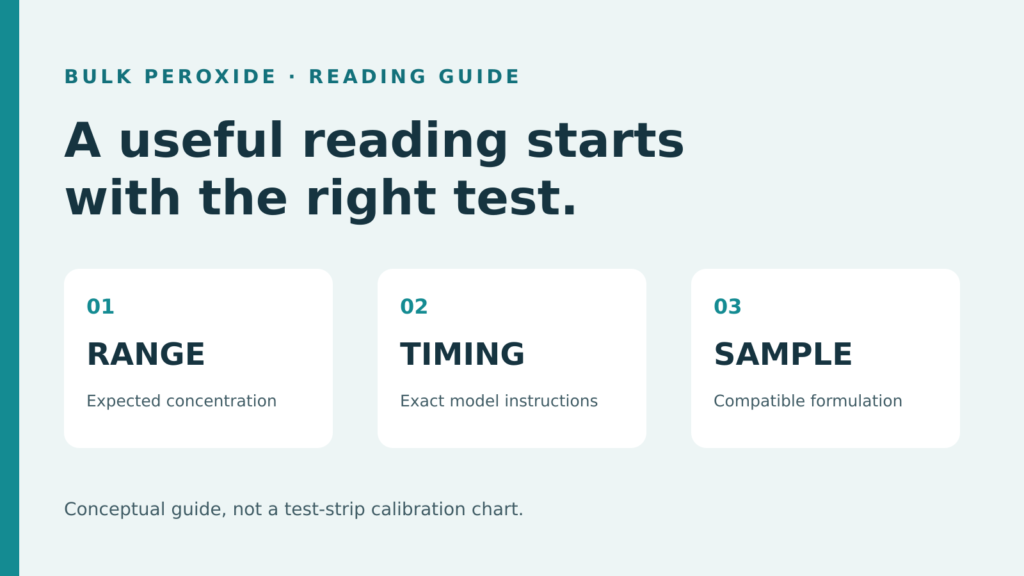
Choose a hydrogen peroxide test strip for the concentration you expect, then read it with its own chart and timing instructions. A 0–100 ppm strip is a low-range test. It cannot directly measure an undiluted bottle of 3%, 12% or 35% peroxide.
The result is a color estimate, not a laboratory assay. That distinction matters if you are trying to decide whether a bottle meets a narrow strength specification: a strip may show that two samples are in the same broad range without showing whether they have the same concentration.
Range and precision are different things
Think of a ruler. Its length tells you what it can measure; its smallest marks tell you how closely you can read it. Test strips have a similar distinction.
| Label detail | What it tells you |
|---|---|
| Range | The span of concentrations the test is designed to measure, such as 0–100 ppm. |
| Chart steps | The marked levels you can compare with the test pad. They may be widely or unevenly spaced. |
| Detection limit | The smallest amount the manufacturer says the method can detect. |
A color test is often called semiquantitative: it estimates an amount rather than reporting an exact value. As an example from another manufacturer, Bartovation’s low-range technical sheet gives color-chart increments and an accuracy limit tied to those increments. Those specifications are not the specifications for Bulk Peroxide’s strips.
Use the chart that belongs to your strips
Bulk Peroxide sells 0–100 ppm hydrogen peroxide test strips. Use the directions and chart supplied with the actual package. The catalog photo does not show the full timing instructions, so we do not invent a dip time or read time here. If those instructions are missing, ask for the matching instructions before testing.

Before testing, check the strip model, expiry, storage requirements and whether the method suits your sample’s ingredients. Follow the specified dip and reading times. Compare with the matching physical chart or another comparison method explicitly approved by the manufacturer—not a random chart on a phone.
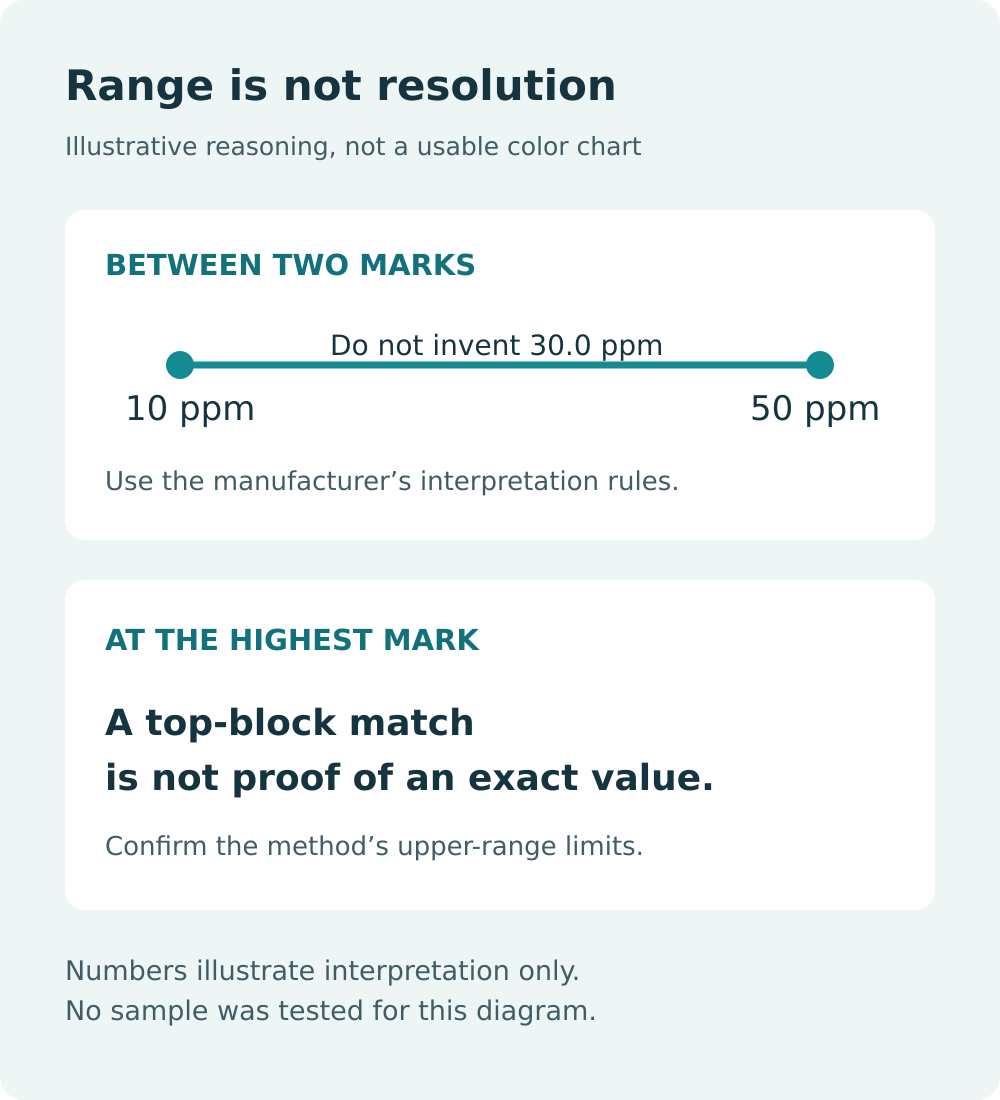
Record a result such as “closest match to the 50 ppm block.” Do not turn an uncertain match into “48.7 ppm.” Likewise, a match to the highest block is not proof of an exact concentration, and no visible color does not establish that absolutely no peroxide is present.
Hypothetical example: if a chart has marks at 10 and 50 ppm and the sample falls between them, you cannot simply report 30.0 ppm unless the test maker supports that interpretation. If your decision depends on a small difference, ask for a method that can resolve it. Our guide to peroxide specifications and COA results explains how formal limits differ from a rough reading.
Why percent and ppm can cause confusion
Percent means parts per hundred; ppm means parts per million. When they describe the same fraction, 1% equals 10,000 ppm. So 3% by mass equals 30,000 milligrams per kilogram (mg/kg)—far outside a low-range strip’s direct measurement range.
Milligrams per liter (mg/L) is different: it describes mass per volume. Converting between mg/kg and mg/L requires the liquid’s density. For dilute water samples, mg/L is often approximately the same numerical value as ppm by mass, but that shortcut is not valid for every concentrated solution. Confirm what your strip maker means by “ppm.” NIST’s guidance on expressing quantities explains why clear units matter.
Can low-range strips verify a concentrated bottle?
No—not by testing the concentrated liquid directly, and not by treating a color match as proof of its original strength. A 0–100 ppm strip is designed for a different concentration range from a bottle labeled 3%, 12% or 35%.
Trying to bring a concentrated sample into range adds handling hazards and measurement uncertainty. This guide does not provide a sample-preparation method. If you need to verify stock strength, ask the supplier or a qualified laboratory which validated test is suitable for the actual product.
Even an in-range result is limited by the spacing of the color chart and the test’s accuracy. Two samples with different concentrations may match the same color block. That is why a rough strip reading cannot certify a narrow product specification.
Keep the original label and lot information with your request. A nominal product name such as “35%” is not a laboratory result for the bottle in your hand. For example, Bulk Peroxide’s linked product SDS identifies 34.5% hydrogen peroxide and warns of severe skin burns and eye damage. Use the current documentation for your actual product; do not use a low or unclear strip reading to decide that concentrated peroxide is safe to handle.
When a strip is not enough
A strip must suit the formulation, not just the expected strength. Bartovation’s technical sheet, for example, notes responses to other oxidizers and limitations with some formulated peroxide products. Do not change a sample’s acidity or add chemicals to make a strip work; use a method supported for that sample.
For an accurate concentration check, request the lot’s Certificate of Analysis (COA) or a qualified laboratory assay. A COA describes the tested lot sample; it does not establish the current concentration of an opened bottle. The SDS and COA serve different purposes, and storage history matters too.
Before buying strips, tell the supplier your expected concentration, sample ingredients and the decision you need to make. “Is peroxide present at a low level?” and “Does this bottle meet a narrow concentration specification?” are different questions—and may need different tests.
