
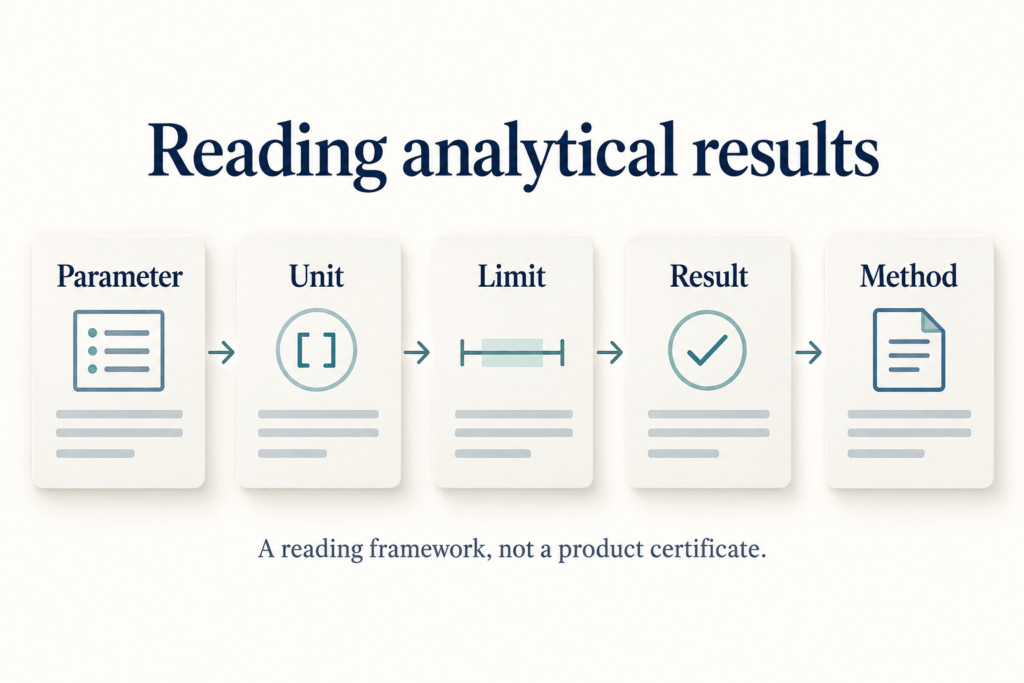
Read a hydrogen peroxide specification one row at a time: identify the parameter, confirm its unit and basis, distinguish the acceptance limit from the reported result, and check any method or reporting qualification. A number that meets an assay requirement does not answer every impurity question. A “PASS” entry does not necessarily provide a measured concentration.
This guide starts with the analytical table. For help choosing the right document and matching it to an order, see hydrogen peroxide SDS vs. COA. Here, the task is narrower: understanding what each result actually supports.
Assay and impurity limits answer different questions
An assay row reports hydrogen peroxide content on the stated basis. Separate impurity rows address named substances or specified groups. Residue and identification may appear as additional tests. They are not interchangeable measures of a single, universal “purity” score.
For example, Spectrum Chemical’s historical HY115 documentation lists assay, iron, lead, residue on evaporation and identification separately. Its sample certificate is for a lot manufactured in 2020, with a 2021 expiration date. It illustrates a reporting format—not a current Bulk Peroxide specification or lot result. Source: Spectrum HY115 documentation, pages 3–4 (PDF).
When reviewing an aqueous peroxide solution, do not read everything outside the peroxide assay as contamination. Equally, do not treat an acceptable assay as proof that every impurity requirement has been met. Review the particular parameter your purchasing requirement names.
A reading key for the analytical table
The examples below are conceptual. They contain no product limits or test results and are not a substitute for the supplier’s specification.
On a narrow screen, scroll the table horizontally to read all four columns.
| Row or entry | What to read | What not to infer | Clarification to request |
|---|---|---|---|
| Assay | Peroxide content, its stated basis and its acceptance criterion. | That all named impurities meet your requirements. | Which assay basis and specification revision apply? |
| Named impurity | The exact substance or group, unit, acceptance criterion and reported result. | That a result for one substance covers other substances. | Does this parameter match the requirement you need evaluated? |
| Residue on evaporation | The separate residue criterion and its reported outcome. | That this row identifies or individually quantifies every impurity. | What does the referenced test cover? |
| Identification: PASS | A qualitative outcome against the specified identification criterion. | A numerical assay or complete impurity profile. | Which identification test and criterion are referenced? |
| Blank or unlisted parameter | No usable result for that parameter in the table you have. | Zero, absent, tested or compliant. | Is a result available elsewhere, or is the parameter outside the report’s scope? |
The distinction between numeric, less-than and qualitative entries is visible in Thermo Fisher’s historical H325 certificate, which separates units, specifications and test values. It describes ACS material, not an equivalent food-grade product or Bulk Peroxide inventory. Source: Thermo Fisher H325 certificate, page 1 (PDF).
Separate the acceptance criterion from the result
A specification states the requirement; the result states the reported outcome. A minimum, a maximum and a two-sided range impose different conditions:
- Minimum: read the lower boundary and the printed comparison sign.
- Maximum: read the upper boundary and the printed comparison sign.
- Range: check both boundaries and whether the endpoints are included.
“Less than” and “less than or equal to” are not the same statement. Nor is a nominal concentration in a product name automatically the exact acceptance criterion. Use the requirement printed in the applicable specification, not a tolerance you infer from the label.
If a result is near a boundary, ask how the supplier applies rounding and any relevant measurement uncertainty when determining conformity. Do not add your own tolerance or round a result into acceptance. If your purchase requirement differs from the supplier’s criterion, record that difference rather than treating a supplier’s pass as an answer to a different question.
Check the unit and the basis before comparing numbers
Units are part of the result. When an assay is expressed as a mass-fraction percentage, it means the mass of hydrogen peroxide divided by the total mass of the solution, multiplied by 100—not a volume percentage. If a supplier uses ppm to mean a mass fraction (often labeled w/w), 1 ppm corresponds to 1 mg/kg. A value in mg/L instead expresses mass per volume; it cannot simply be substituted for mg/kg without the relevant density and a defined basis. A bare “ppm” or “%” may need clarification. NIST recommends identifying the quantity explicitly and favors expressions such as mg/kg over ppm in SI writing. Source: NIST SI Guide, Chapter 7.
Before comparing two supplier tables, ask whether both describe the same parameter on the same basis. Preserve qualifiers such as “as” followed by a named substance; do not silently drop them when recording a requirement. If the headings leave the comparison unclear, request a written explanation rather than a guessed conversion.
Read less-than and PASS results without filling in the blanks
A less-than result is not zero
A result written as “<x” reports a value below the stated threshold, not the number zero. The symbol alone does not tell you whether that threshold is a detection limit, a quantification limit, a reporting limit or a specification-related reporting threshold. Ask the issuer what it means in that report.
Detection and quantitative determination are distinct measurement concepts. NIST explains why recognizing a signal and measuring its amount require different limits; a report’s notation should not be assigned one of those meanings without supporting information. Source: NIST, Limits for Qualitative Detection and Quantitative Determination.
If the reported threshold is above the maximum your purchase requirement allows, the entry alone does not establish compliance with your tighter requirement. Ask whether the supplier can provide evidence appropriate to that requirement. Do not replace the less-than entry with an invented exact value.
PASS is a conclusion, not necessarily a concentration
Read “PASS” together with its row heading and criterion. A qualitative identification result should stay qualitative in your review notes. If a quantitative parameter is reported only as conforming, ask whether a numerical result is available when your acceptance process needs one. Do not convert “PASS” into an assumed number.
Check the method and the dates that qualify the result
A method reference tells you where to ask the next question; it does not, by itself, explain reporting thresholds or how a borderline result was evaluated. If a decision depends on those details, ask the supplier or issuing laboratory to clarify:
- The method and revision applicable to the particular parameter.
- The meaning of any reporting qualifier, including a less-than entry.
- Whether the reported evidence can address your specified limit and basis.
- The decision rule used for conformity if rounding or uncertainty matters to acceptance.
Keep specification revision, test or release date, and any retest or expiration date distinct. A historical certificate is not a fresh analysis of current stock. The Thermo Fisher example explicitly identifies a lot, a release date and a suggested retest date; the Spectrum sample is likewise tied to its own historical lot. Their dates are context for those documents, not dates to apply to your purchase.
This is a document-review process, not an instruction to perform an assay or check concentrated peroxide yourself. Refer unresolved analytical questions to the supplier and your organization’s qualified quality personnel.
Turn an unclear row into a precise supplier question
Instead of asking only whether the peroxide is “pure,” identify the missing evidence: “For this product and lot, does the reported result for [parameter] address our maximum of [requirement] in [unit and basis]? Please explain the reported qualifier and identify the applicable method and specification revision.”
Keep the unresolved point open until it is answered. A useful review note records the parameter, your criterion, the supplier’s reported entry and the clarification still needed. It should not rewrite an incomplete entry as a passing result.
For the separate question of grade versus concentration, see what food-grade hydrogen peroxide means. When reviewing the Bulk Peroxide 35% product listing, request the applicable product and lot documentation rather than transferring limits from the third-party examples in this guide.
Frequently asked questions
Can I compare two COAs just by choosing the lower impurity number?
Not reliably until the parameter, units, basis and reporting qualifiers match. Two less-than results with different thresholds do not necessarily reveal which material has the lower actual impurity content.
Does a missing impurity row mean the material contains none?
No. It means that the table does not supply that result. Ask whether the parameter is covered by another document or is outside the reported test scope.
Does an assay result establish the product’s grade?
Do not use assay alone to make that conclusion. Review the applicable grade specification and the evidence addressing its requirements; concentration and grade are separate questions.
