
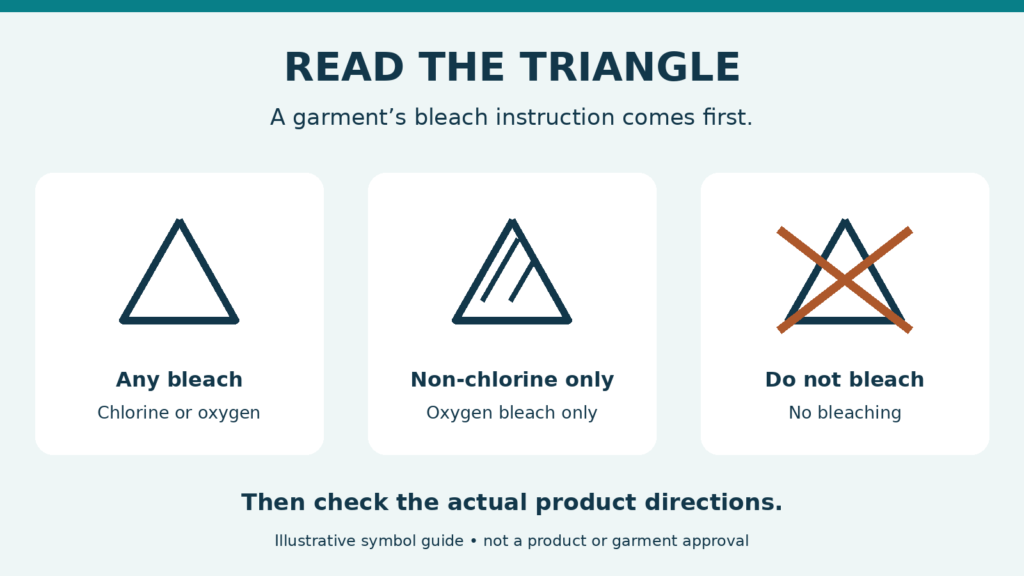
An empty triangle allows chlorine or oxygen bleach. A triangle with two diagonal lines allows oxygen bleach only. A crossed-out triangle means do not bleach. Read the words beside the symbol too, along with the garment’s washing and drying instructions.
The part that causes confusion is “non-chlorine.” Some laundry bleaches use hydrogen peroxide, but that does not make a bottle of peroxide interchangeable with a formulated laundry product.
The three bleach symbols, at a glance
| Symbol on the garment | Meaning | What to look for on the laundry product |
|---|---|---|
| Empty triangle | Chlorine or oxygen bleach is allowed. | A product intended for that garment and wash method. |
| Triangle with two diagonal lines | Oxygen bleach only; no chlorine bleach. | Non-chlorine or oxygen bleach, with directions that fit the garment. |
| Crossed-out triangle | Do not bleach. | A bleach-free detergent, not an alternative type of bleach. |
GINETEX’s care-symbol guide gives these meanings. Permission to bleach does not require bleaching every load; it tells you what the garment can tolerate when bleaching is appropriate.
Why the rest of the label still matters
The bleach symbol answers one question. The wash temperature, cycle and drying symbols answer different ones. A garment can allow oxygen bleach but still require a gentle cold wash and air drying.
Read the label for the complete garment, not just its main fiber. A cotton shirt with a printed design or trim is not necessarily cared for like a plain cotton towel.
- Hypothetical example: a white shirt with a crossed-out triangle. Its color does not override the no-bleach instruction.
- Hypothetical example: a colored garment with a striped triangle. Oxygen bleach is the permitted category, but you still need a suitable laundry product and must follow its directions.
- Hypothetical example: an empty triangle beside a cold-wash instruction. Bleach permission does not mean you can switch to a hot wash.
Where hydrogen peroxide fits
Hydrogen peroxide is an oxygen-bleach ingredient. “Oxygen bleach” names a category, though, not one universal formula or strength. Product directions matter because the ingredient alone does not tell you the dose, fabric restrictions or intended use. See the American Cleaning Institute’s cleaning-product glossary for the distinction between chlorine and oxygen bleaches.
Do not interpret the striped triangle as permission to pour concentrated 35% peroxide onto clothing or into a washer. Choose a laundry product whose label fits the garment and your washer, rather than improvising from an ingredient name.
What if the label uses words, or the triangle is missing?
Look for wording such as “only non-chlorine bleach when needed” or “do not bleach.” U.S. labels can communicate care through words or approved symbols; the FTC’s care-labeling guidance explains the labeling requirements.
If the tag has worn away, check the brand’s listing or ask its customer-care team using the style number. A missing symbol is not proof that every bleaching method is suitable.
Can a spot test overrule “do not bleach”?
No. A test on an inside seam cannot cancel a care restriction. Use a test only as directed for a product and method that are otherwise allowed.
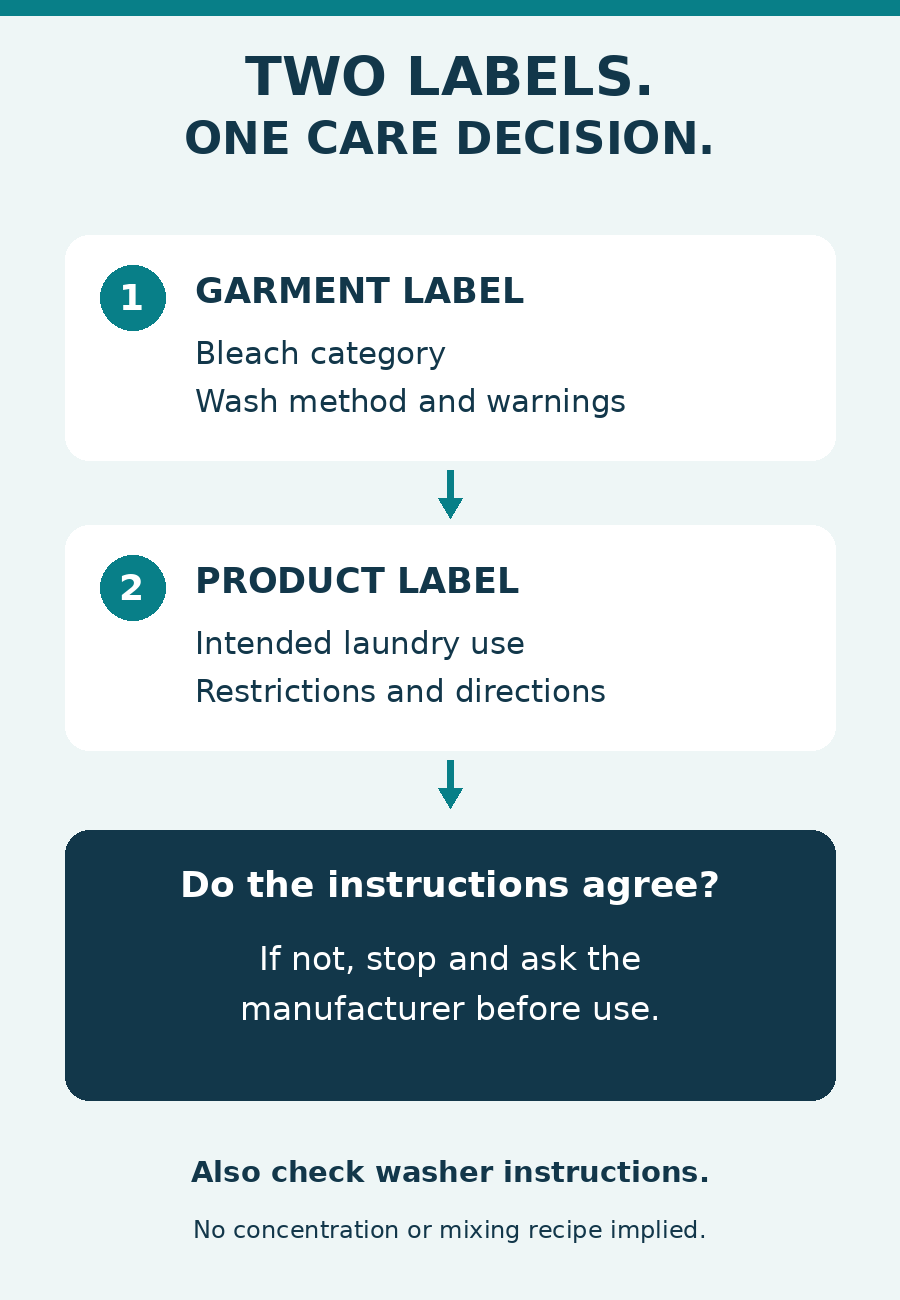
The simplest shopping check is to read both labels before buying: does the garment allow this type of bleach, and does the product say it is suitable for the garment? If either answer is unclear, choose a different permitted method or ask the manufacturer.
Furniture labels use a different system. For a sofa or chair, read our W, S, WS and X upholstery-code guide rather than applying laundry symbols to the whole piece.
