
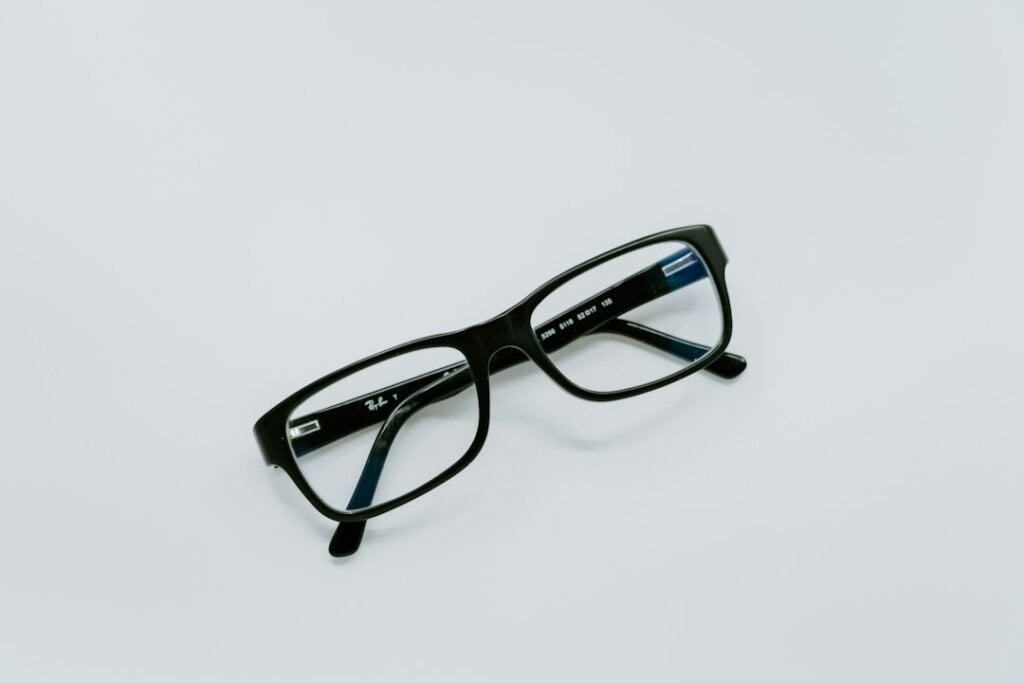
Featured photo: Check the care instructions for your own lenses and frame. Photo by Claudio Schwarz on Unsplash.
For everyday cleaning, skip household hydrogen peroxide on your eyeglasses. Use it only if the makers of your exact lenses and frame approve that product and method. Otherwise, choose their recommended lens cleaner or care routine.
The useful question is whether a cleaner suits the whole pair: the lenses, any coatings, the frame and its details. Warby Parker’s cleaning guide, for example, recommends lotion-free dishwashing liquid or a glasses-cleaning solution approved for lens coatings.
This guide covers ordinary eyeglasses and sunglasses. Smart glasses and frames with special decorations need extra care, as explained below.
Why there is no single peroxide answer for every pair
Eyeglass lenses can have several surface treatments. An anti-reflective coating reduces reflections. A hard coating improves scratch resistance. Other coatings make dirt and water less likely to stick. ZEISS explains these different coating layers and why they serve different purposes.
That is why knowing only that a lens is “glass” or “plastic” leaves part of the cleaning decision unanswered. Scratch resistance also does not tell you which liquids the manufacturer permits.
Check the care card, your order details or the maker’s website. If you cannot identify the coating or frame material, ask the optical shop that supplied the glasses. A quick question is a better starting point than trying a homemade peroxide spray on an expensive pair.
| Part of the glasses | What you need to know |
|---|---|
| Lenses and coatings | Which cleaning products are approved for this exact lens and coating? |
| Frame and nose pads | Does the frame maker allow the same method on these parts? |
| Decorative details | Are there fabric, leather, pearl or other details with separate care instructions? |
| Smart features | Do cameras, charging contacts or other electronics require a damp-cloth method? |
A simple cleaning routine for ordinary glasses
For glasses whose care instructions permit washing, the following routine follows Warby Parker’s five-step method. Read the special-frame exceptions before taking your pair to the sink.
- Clean your hands. Wash and dry them before handling the glasses.
- Rinse gently with lukewarm water. Remove loose dust before rubbing. Avoid hot water.
- Use a small drop of lotion-free dishwashing liquid on each lens. Gently work it over both sides and the frame with your fingers.
- Rinse away the soap. Include the nose pads and arms.
- Dry gently. Use a clean microfiber cloth, then check for remaining smudges.
Two important exceptions to the sink routine
Frames with fabric, pearl or leather
CHANEL’s eyewear care instructions allow gentle soap-and-water cleaning generally, but specify a soft cloth only when a frame features fabric, pearl or leather. The same page advises against solvents, alcohol and abrasive cloths.
Those are CHANEL’s instructions for its eyewear. For another brand, check that maker’s guidance rather than treating a decorative frame like a plain one.
Smart glasses with electronics
Ray-Ban’s U.S. Meta FAQ specifies a dampened cloth and mild soap, says not to hold the glasses under running water, and advises drying them before wearing or returning them to the charging case. It also excludes solvents, alcohol and dirty or abrasive cloths.
Use the current instructions for your exact smart-glasses model. An ordinary eyeglass cleaning routine should not override its water limits.
How to choose a lens cleaner without guessing
Look for a product intended for eyeglasses, then check that its instructions cover your coatings. For example, ZEISS identifies its Lens Wipes as suitable for high-quality coated lenses. It also lists anti-reflective lenses among the uses for its Lens Cleaning Spray.
That approval belongs to those named products. It does not establish that any household cleaner, peroxide solution or wipe with a similar-looking ingredient list will work on your glasses.
Application directions matter, too. In its glasses-care guide, ZEISS recommends putting its spray on the microfiber cloth rather than directly on the lenses. It notes that repeated liquid entry into drill or screw holes can cause problems over time.
Keep a clean cloth with your approved cleaner so you have a suitable option ready. Follow the cloth’s washing instructions, and replace it when it is no longer clean enough for the job.
What if you already used peroxide?
Stop using it and check the care instructions before doing anything else. Do not try another chemical to reverse the result, or scrub harder at a cloudy patch.
Ask your optician or the manufacturer about the exact product you used. Have the bottle label, the approximate contact time and your glasses’ model information ready. If the lenses remain hazy or a finish looks changed, arrange an inspection rather than guessing whether the mark is residue or damage.
Do not try to polish out scratches at home. ZEISS’s care guide explains that scratches cannot be removed from plastic or glass lenses by cleaning.
Common questions
Is 3% hydrogen peroxide safe for glasses?
The percentage alone cannot answer that. You still need approval for the particular cleaner, lenses, coatings and frame. Do not use a lower concentration as a substitute for the manufacturer’s care instructions. Our guide to reading peroxide labels explains why the product name and strength are only part of the information you need.
Can I use peroxide just on the frames?
Only if the frame maker approves that exact product and method. Approval for a frame would not automatically include the lenses, nose pads or decorative parts. If that permission is unclear, use the frame’s recommended care routine.
Does an anti-reflective coating mean I cannot clean the lenses?
No. Use a cleaner approved for that coating and follow its directions. The ZEISS products described above are examples of products with stated coated-lens uses, rather than permission to use every cleaning spray.
Can peroxide fix scratched or cloudy lenses?
Do not use it as a repair treatment. A persistent cloudy area needs an inspection, and cleaning cannot restore a scratched surface. Take the glasses to the shop that supplied them if your usual approved cleaning method does not resolve the problem.
The practical takeaway: Keep household peroxide out of your everyday glasses-care routine unless your eyewear manufacturer specifically approves it. A compatible cleaner, a clean cloth and the instructions for your exact pair are the useful essentials.
