
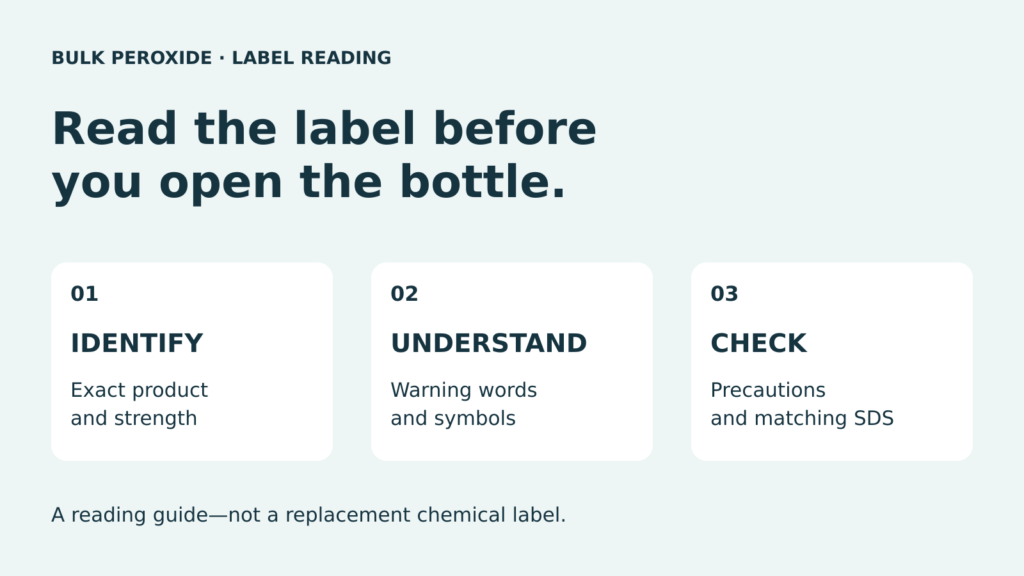
Read a hydrogen peroxide label as a set of instructions, not just a collection of warning symbols. First identify the product and concentration. Then read the written hazards and precautions beside the pictograms. A symbol tells you the type of hazard; the accompanying words tell you what that warning means for this particular product.
This guide explains the main parts of a U.S. workplace hazardous-chemical label. Consumer and transport labels can look different, so it is not a replacement for the directions on your actual container.
Start with the name and strength
“Hydrogen peroxide” identifies the chemical, but it does not tell you the concentration or formulation. Two bottles can share that name and need different precautions. Match the container to the product you ordered before interpreting the rest of the label.
The CAS number identifies the chemical, not the product’s concentration.
For more detail, use the matching safety data sheet, or SDS. Its product identifier should connect to the labeled product. Our SDS vs. COA guide explains where safety information ends and batch-test information begins.
The six parts of a workplace hazard label
OSHA’s label guide identifies these six elements:
- Product identifier: the name or code that connects the label to the SDS.
- Supplier details: who supplied the chemical and how to contact them.
- Signal word: “Danger” or “Warning,” where required.
- Pictograms: hazard symbols, usually black on white inside a red diamond.
- Hazard statements: the written description of the hazards.
- Precautionary statements: steps for prevention, response, storage and disposal.
Do not stop reading after the first familiar symbol. The written statements are what turn a general warning into information you can act on.
What the common symbols mean
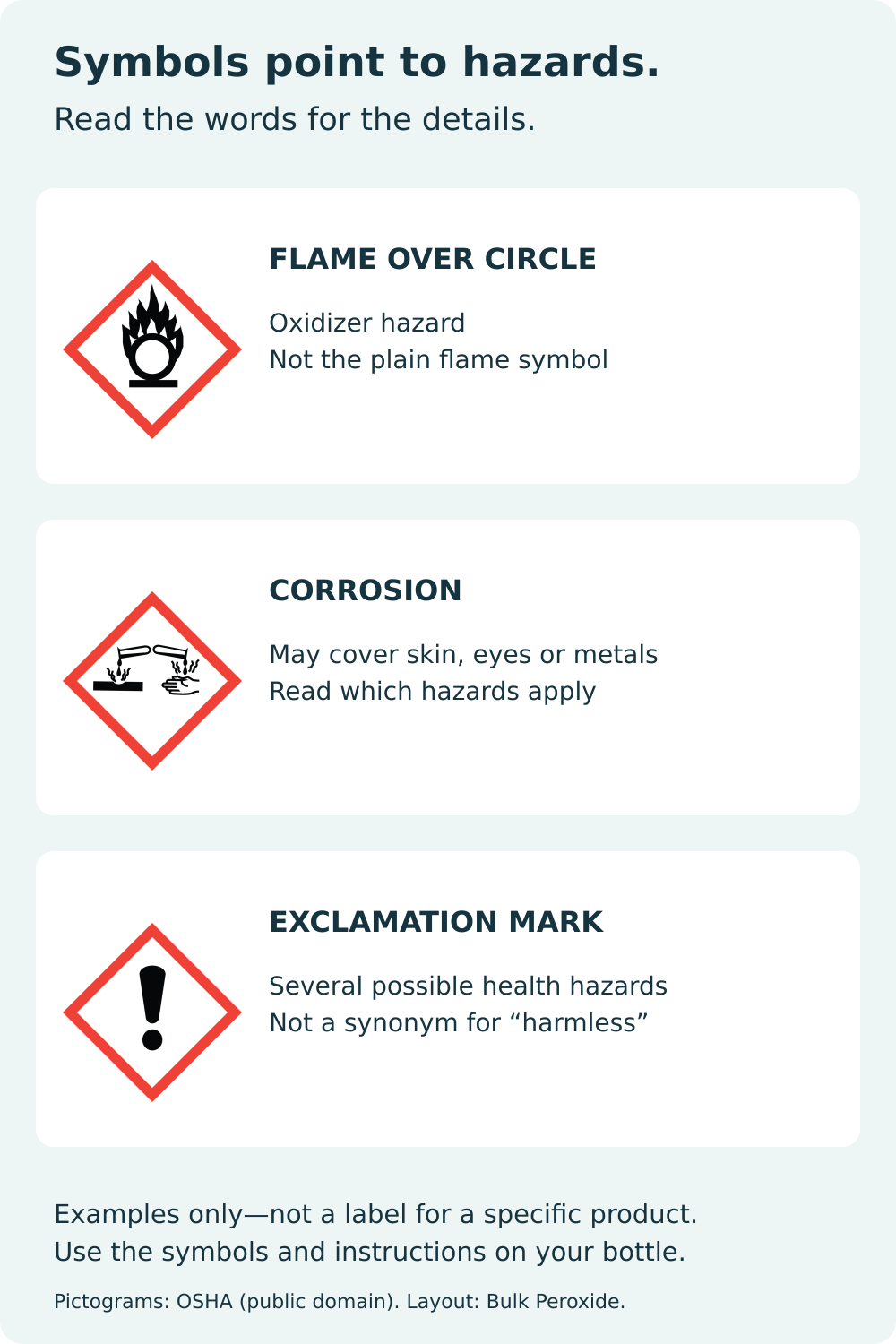
The illustration shows selected official OSHA pictograms for learning purposes. It is not a proposed label for any Bulk Peroxide product.
Flame over a circle: oxidizer
This warns of an oxidizing hazard. It is different from the plain flame symbol. An oxidizer can contribute to a fire involving other materials; the symbol does not simply mean that the liquid itself is a fuel.
Corrosion: serious injury or damage hazards
The corrosion symbol can apply to skin corrosion, serious eye damage or corrosion of metals. Read the hazard statements to learn which classifications apply. Do not assume every meaning applies whenever you see the pictogram.
Exclamation mark: do not dismiss it as a minor warning
This symbol covers several hazards, including certain irritation and harmful-exposure categories. It does not mean “safe enough to ignore.” Again, the accompanying words identify the actual warning.
See OSHA’s pictogram reference for the full symbol set and associated hazard classes.
“Danger” and “Warning” are not interchangeable
Within OSHA’s labeling system, “Danger” is used for more severe hazard categories and “Warning” for less severe ones. “Warning” does not mean harmless. You also cannot rank two products by counting their symbols: different hazards can share a pictogram.
For example, if two labels both display the corrosion symbol, compare their written hazard statements and precautions. The shared icon alone does not establish equal strength or equal handling requirements.
If the label is missing or hard to read
Do not guess the contents from the bottle shape, smell or a bubbling test. Avoid using an unidentified product. Contact the supplier or the person responsible for chemical safety at your workplace for the correct identification and labeling.
A shipping page or a photograph of a different bottle is not a substitute for a readable label on the actual container. If the label and paperwork appear to describe different products, resolve that before use. You can contact Bulk Peroxide with the order details and a safely obtained label photograph.
The useful habit is simple: identify the product, read the hazard statements, then follow the precautions. The pictograms help you find the warnings; they do not replace reading them.
