
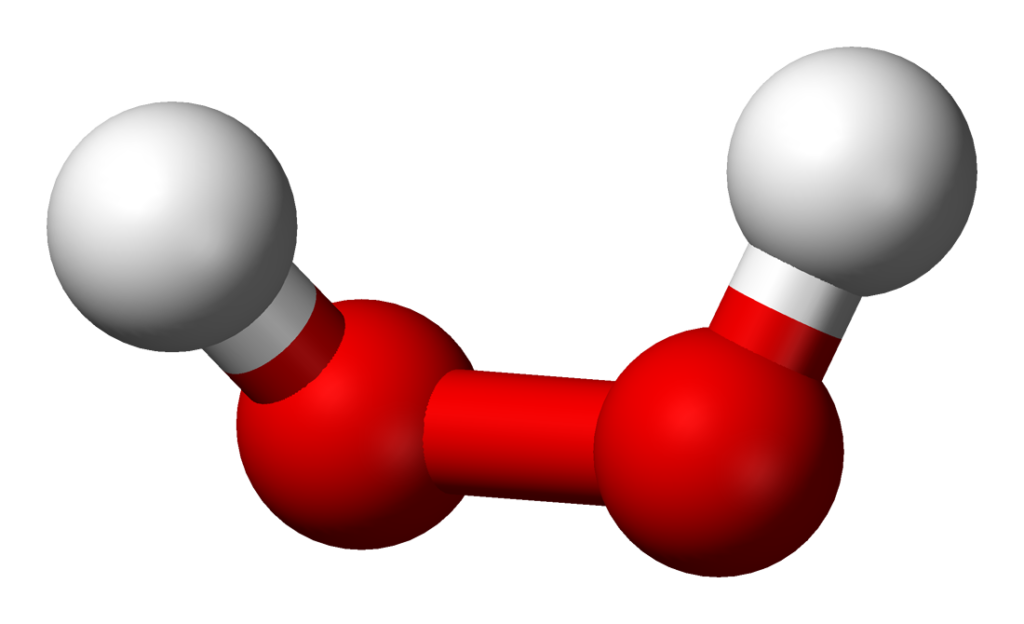
Hydrogen peroxide has the molecular formula H₂O₂ and the connected structure H–O–O–H. Each oxygen bonds to one hydrogen and the other oxygen. The molecule is not a straight chain or a flat zigzag: its four atoms form a twisted, three-dimensional arrangement.
A formula, a Lewis diagram and a ball-and-stick model all describe the same molecule. They simply show different kinds of information. Knowing which view you are looking at clears up a common question: how can peroxide be called “bent” in one explanation and “nonplanar” in another?
Start with the formula: two hydrogen atoms, two oxygen atoms
The small numbers in H₂O₂ count atoms in one molecule. There are two hydrogen atoms and two oxygen atoms, for four atoms altogether. The NIST Chemistry WebBook records this formula and its structural identity.
The formula alone does not show which atoms connect. Writing H–O–O–H adds that information: there are two O–H bonds and one O–O bond. It is a connection map, not a promise that all four atoms sit in a straight line.
The Lewis structure shows bonds and lone pairs
A Lewis structure uses lines for shared electron pairs and dots for electrons outside those bonds. For H₂O₂, draw the H–O–O–H connections, then put two lone pairs on each oxygen. A lone pair is a pair of electrons that is not forming one of those bonds. Wayne Breslyn’s H₂O₂ tutorial highlights the two lone pairs on each oxygen.
A quick check uses 14 valence electrons, meaning electrons counted from the atoms’ outer shells. Two oxygens contribute 12; two hydrogens contribute two. The three bonds account for six electrons, leaving eight in four lone pairs. This follows the standard Lewis-structure method explained by OpenStax.
“Bent” describes each oxygen; “nonplanar” describes the whole molecule
Look at one oxygen at a time. Its two bonded neighbors do not lie along a straight line, so the local arrangement is bent. The two lone pairs also matter when describing the surrounding electrons.
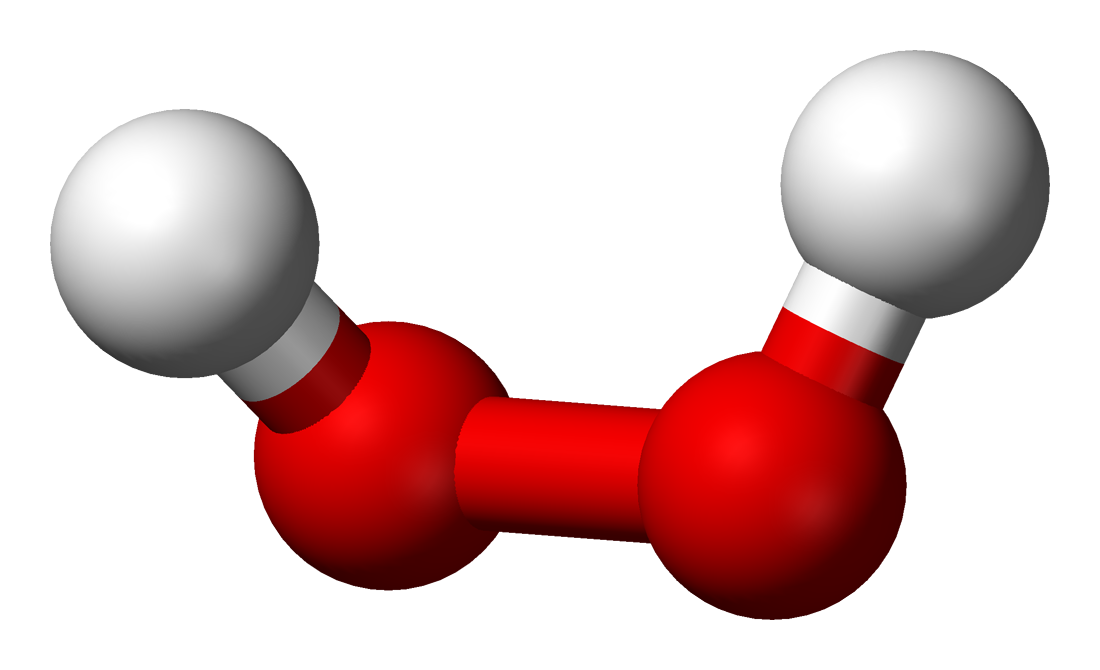
Now look at all four atoms together. The H–O–O group on one end and the O–O–H group on the other are twisted relative to each other. They do not all lie in one plane. Chemists call that nonplanar.
The distinction is between a local shape and the shape of the complete molecule. NIST’s experimental geometry record lists both a three-atom H–O–O angle and a four-atom H–O–O–H dihedral angle. Those are different measurements.
Why not call the whole molecule tetrahedral?
In a basic electron-pair model, each oxygen has four regions around it: two bonds and two lone pairs. That gives a tetrahedral electron-pair arrangement around each oxygen. But molecular shape counts the atom positions, not the lone pairs as extra atoms. The bonded neighbors around each oxygen therefore make a bent shape. OpenStax explains this difference between electron-pair geometry and molecular structure.
H₂O₂ also has two oxygen centers, not one atom sitting at the center of a four-cornered molecule. “Tetrahedral around each oxygen’s electron regions” and “twisted overall” answer different questions.
A simple way to read any H₂O₂ drawing
- Formula: count the atoms.
- Lewis structure: check the three single bonds and four lone pairs.
- 3D model: look for the twist, rather than treating the flat formula as the shape.
These bonds hold one molecule together. Attractions between neighboring molecules are a separate topic, covered in Can Hydrogen Peroxide Form Hydrogen Bonds? For the broader chemical family, see peroxide versus hydrogen peroxide.
