
In everyday conversation, “peroxide” often means hydrogen peroxide. In chemistry, the word is broader: hydrogen peroxide is one member of a family of peroxide compounds. So the names can refer to the same bottle in casual speech, but they are not interchangeable on every ingredient list.
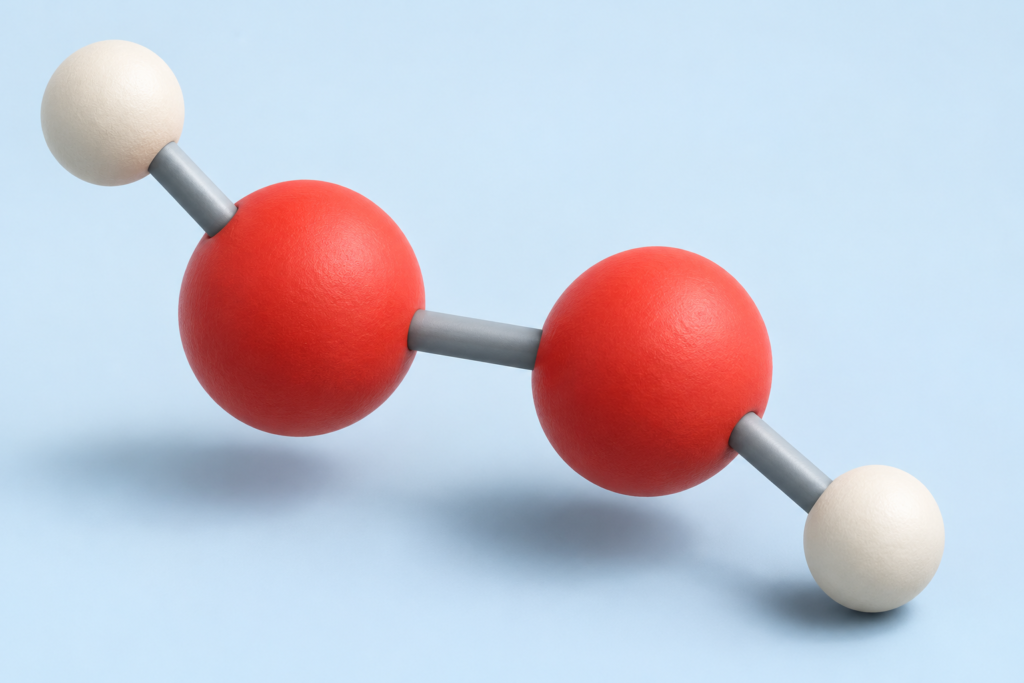
About the illustration: two red oxygen atoms and two white hydrogen atoms form a simplified molecular model. Colors, sizes and bond angles are illustrative.
The NIOSH entry for hydrogen peroxide lists “peroxide” among its common names. Chemical references also use the word for other substances. The context makes the difference.
One word, three meanings
| Where you see it | What it can mean |
|---|---|
| Everyday conversation | A shortened name for hydrogen peroxide, usually a solution in water. |
| A discussion of peroxide compounds | A family of chemicals with a characteristic oxygen–oxygen connection. |
| The term “peroxide ion” | O₂²⁻: two joined oxygen atoms carrying a total charge of minus two. |
These meanings come from the NIOSH chemical entry, UCLA’s illustrated chemistry glossary and the IUPAC definition of peroxides. “Ion” simply means a particle with an electrical charge.
What makes hydrogen peroxide specific?
Hydrogen peroxide has the formula H₂O₂. Each molecule contains two hydrogen atoms and two oxygen atoms, connected in the order H–O–O–H. The two oxygen atoms share a single bond. The dashes show connections between atoms, not the molecule’s actual three-dimensional shape. UCLA’s molecular diagrams show hydrogen peroxide alongside other peroxide compounds.
Think of “peroxide” as the family name and “hydrogen peroxide” as the full name of one member. The family name alone does not identify everything in a product.
For example, sodium peroxide has the formula Na₂O₂, while hydrogen peroxide is H₂O₂. The word they share points to related chemistry, not matching ingredients or a reason to substitute one for the other.
Read the full name before the percentage
A shopping note that says only “peroxide” leaves out useful information. First find the full chemical or product name. Then check the concentration and the product’s intended use.
For hydrogen peroxide, NIOSH lists CAS number 7722-84-1. That number identifies the chemical; it does not tell you the concentration or complete formulation. Our hydrogen peroxide CAS-number guide explains that distinction.
A Safety Data Sheet (SDS) can help resolve an unclear name. Section 1 identifies the product, while Section 3 gives composition information. OSHA’s SDS guide explains both sections. An SDS may report ingredient ranges rather than a complete recipe.
If the name is sodium percarbonate, use our separate powder-versus-liquid comparison. That is a different buying question from whether someone shortened “hydrogen peroxide” to “peroxide.”
The useful takeaway: “Peroxide” may be convenient shorthand. For a purchase or product choice, use the full name, concentration and exact product instructions.
