
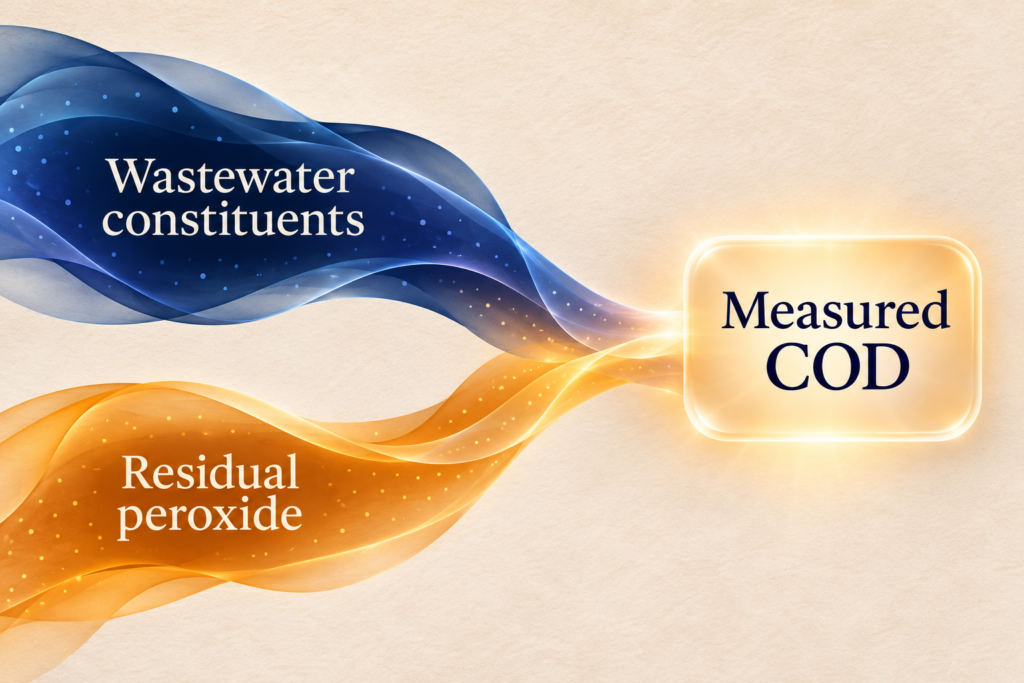
Residual hydrogen peroxide can make a dichromate chemical oxygen demand (COD) test read high. Peroxide left in the wastewater sample can contribute to the test’s chemical response. A higher COD result after a peroxide-based treatment stage therefore needs a closer look before it is taken as evidence that organic pollution increased.
The useful distinction is between what happened in the treatment process and what happened in the test. An interference can complicate that comparison, but it does not establish that treatment succeeded or failed. Here is how to read the result and ask the laboratory a more useful question.
What a COD result actually means
COD measures the amount of chemical oxidant consumed under a defined set of test conditions and expresses it as an equivalent amount of oxygen, usually in milligrams of oxygen per liter (mg O₂/L). It gives a combined measure of the substances that respond to that test.
The oxygen unit can be confusing. A COD result of 100 mg O₂/L does not mean that the water contains 100 milligrams of dissolved oxygen per liter. Nor does it identify which pollutant is present. Hach’s technical explanation of COD describes the oxygen-equivalent measurement and the differences between oxygen-demand tests.
That distinction matters when peroxide is part of the process. The test responds to chemistry, not to the reason a substance was added to the water.
Why peroxide can push the number upward
In a dichromate COD test, residual hydrogen peroxide can react with the reagent and contribute a positive interference: a result higher than the reading attributable to the material you intended to assess.
This is a documented analytical issue. A 1992 study in Water Research found COD responses in peroxide-containing synthetic samples even when they contained no organic substances. It also found interference in industrial wastewater samples. The paper’s abstract is available through the EPA’s research reference database.
Peroxide is not the only possible cause of an unexpected result. For example, EPA Method 410.4 identifies chloride and contamination from reagents or laboratory equipment as potential sources of interference. The laboratory needs to consider the actual sample and method rather than stop at the first plausible explanation.
How to read a higher COD result after treatment
Imagine that a facility compares samples collected before and after an oxidation stage. The second COD result is higher, and the second sample still contains peroxide. It is tempting to conclude that the process made the water worse.
Those observations alone do not settle that question. The reported change may include a change in the wastewater, a contribution from residual peroxide, or both. Knowing that peroxide is present identifies something to investigate; it does not tell you the size of its contribution.
Ask two questions separately: Are the samples suitable for the comparison we want to make? And has the laboratory assessed peroxide interference in the reported results? That keeps an unexplained test response from becoming a premature treatment decision.
A repeat test can be useful, but simply obtaining the same number again does not, by itself, rule out interference. A repeatable measurement can still include the same unwanted contribution.
Ask the lab for a comparable result
Send the before-and-after reports together, along with the sampling points and times. Tell the lab that hydrogen peroxide is used in the process. Then ask for these details:
- The COD method and reporting basis. Which method and range were used? Were both samples prepared on the same basis, including whether they were filtered?
- Residual-peroxide information. Was peroxide measured in the samples? Keep its result, units, test method and measurement timing with the COD report.
- The interference assessment. Is the reported COD an unadjusted result, or did the lab use a documented correction or sample preparation to address peroxide?
- Any limits on the comparison. Ask the lab to explain relevant quality-control findings and report qualifications in plain language.
A concise request might be: “These samples were collected around a peroxide-based oxidation stage. Can you explain whether residual peroxide affects this COD comparison, what was assessed, and which reported results are suitable to compare?”
Method-specific evidence matters. Hach’s guidance on water-test interference notes that an unlisted substance may simply not have been studied. Its absence from an interference table is not proof that it cannot affect the test.
Why a generic correction factor is not enough
A correction needs to describe the sample and test being used. It cannot be chosen solely from the concentration printed on the peroxide container.
For example, a 2024 study in Environmental Science & Technology reports correcting COD interference using the peroxide concentration in each sample. That is an example of a study-specific analytical approach, not a ready-made correction for every wastewater stream.
Leave correction calculations and chemical sample preparation to the responsible laboratory’s validated procedure. Research on removing peroxide interference emphasizes preserving the sample’s original COD during that work. Improvised heating or neutralization can alter the sample you are trying to measure. The aim is a defensible result for the original question, not merely a lower number.
Keep the product specification separate
The peroxide strength on a supplier’s certificate describes the supplied product. Residual peroxide describes what remains in a particular wastewater sample. One cannot substitute for the other.
Our guide to peroxide specifications and COA results explains the product-side measurements. For the broader process questions, see the industrial wastewater-treatment overview.
The practical next step is to resolve what the COD result represents before using it to change the process. A suspected interference is a reason to investigate the measurement, not a reason to disregard an unfavorable report.
