
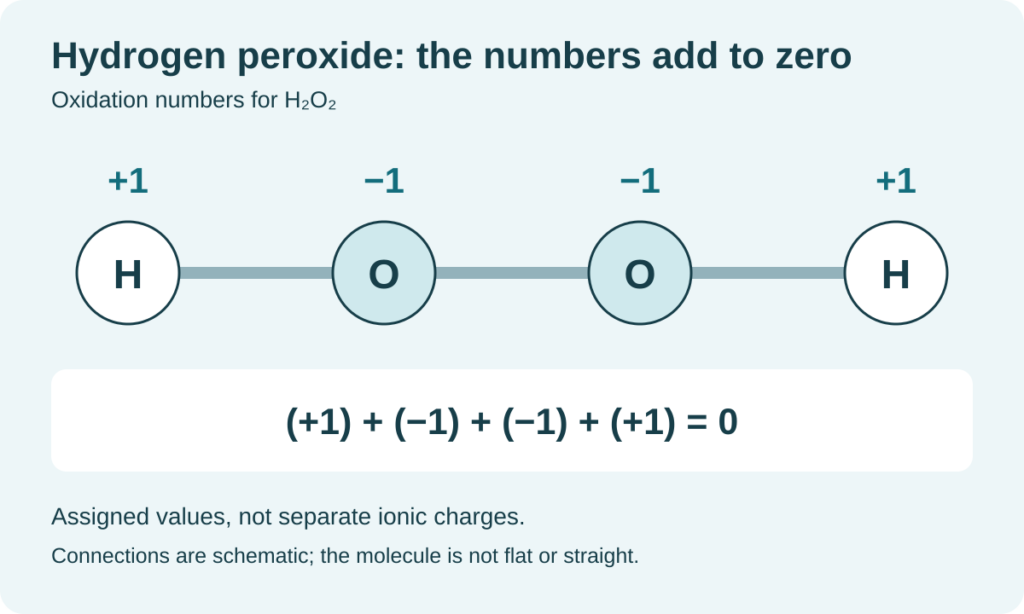
Each oxygen atom in hydrogen peroxide, H₂O₂, has an oxidation number of −1. Each hydrogen is +1. The four values add to zero because the molecule has no overall electrical charge. This is a way to keep track of electrons, not a claim that the molecule contains separate oxygen ions.
About the illustration: oxidation-number bookkeeping, not literal ionic charges. Connections are schematic, not the molecule’s exact three-dimensional shape.
The number often surprises people who learned that oxygen is −2. That is a useful rule for many compounds, but peroxides are an exception. OpenStax’s oxidation-number rules include this exception.
What an oxidation number tells you
An oxidation number, also called an oxidation state, is an assigned value used to follow electrons in chemical formulas and reactions. For a molecule, the calculation imagines assigning shared electrons to particular atoms. It does not measure the actual charge on each atom.
IUPAC’s definition describes this as an ionic approximation of bonds. In everyday terms, it is a counting model. You can use the model without treating a covalent molecule as a bag of separate charged particles.
Work out the −1 in three steps
- Count the hydrogens. H₂O₂ contains two hydrogen atoms. Hydrogen is assigned +1 when bonded to oxygen, giving +2 altogether.
- Make the total zero. The molecule is neutral, so its two oxygens must contribute −2 altogether.
- Divide between the two oxygens. The oxygen atoms have equivalent roles in H–O–O–H. Each therefore has an oxidation number of −1.
Check the sum:
2 × (+1) + 2 × (−1) = 0
The sign matters. The answer is −1 for each oxygen, not −1 for the whole molecule. Purdue’s explanation of peroxides confirms the oxygen value and shows the molecule’s oxygen–oxygen bond.
Why the oxygen–oxygen bond matters
The connections in hydrogen peroxide can be written H–O–O–H. Each oxygen is connected to one hydrogen and to the other oxygen. This sketch shows which atoms connect; it is not the molecule’s exact three-dimensional shape.
In oxidation-number counting, oxygen receives the electrons from its bond to hydrogen because it attracts those shared electrons more strongly. The two identical oxygen atoms divide the electrons in their shared bond equally. Neither oxygen gets an advantage over the other from that bond.
That leaves each oxygen at −1. Oxford’s chemistry explanation walks through this electron assignment for H₂O₂.
Compare water, peroxide and oxygen gas
| Substance | Oxygen’s number | Why |
|---|---|---|
| Water, H₂O | −2 | One oxygen balances two hydrogens at +1 each. |
| Hydrogen peroxide, H₂O₂ | −1 | Two equivalent oxygens share the −2 total. |
| Oxygen gas, O₂ | 0 | Atoms in an elemental substance are assigned zero. |
The table applies the standard oxidation-number rules. It compares chemical identities, not cleaning strength.
What about valency? In the simple bond-counting sense used here, oxygen forms two single bonds in both H₂O and H₂O₂. Its valency is two in each. The oxidation numbers differ because counting bonds and assigning their electrons answer different questions.
For the naming distinction, see peroxide versus hydrogen peroxide. For a practical example of oxidation, our stain-color explanation separates a color change from removal of the whole spill.
Remember: count each atom, keep the signs, and check the total. A −1 oxidation number describes oxygen’s role in this counting model. It is not a concentration, a safety rating or a product-performance score.
