
Pool owners who run their pool on hydrogen peroxide hold it between 50 and 100 parts per million (ppm). Getting there takes three numbers: how much water your pool holds, the strength of the peroxide you pour in, and what your test strip reads right now. The calculator below works out all three for 12% or 35% hydrogen peroxide.
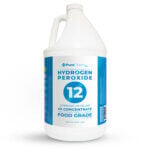
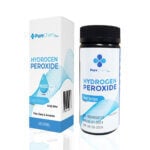 Test before you add. Dip a 0–100 ppm hydrogen peroxide test strip, then use the calculator below for your exact pool and reading.
Pool Peroxide Calculator
Find your pool's volume, then how much 12% or 35% hydrogen peroxide brings it into the 50–100 ppm range.
How big is your pool?
Enter gallons if you know them, or measure the water.
Measure the water, not the pool walls. Depth runs from the water surface to the floor; with a shallow and deep end we use the average.
Choose your hydrogen peroxide
Both reach the same ppm. The difference is how much you pour.
What does your test strip read?
Dip a strip and match the color. Starting fresh? Leave it at 0.
Hydrogen Peroxide Test StripsRead 0–100 ppm · 50 strips per bottle
Free PDF guide
Take the pool peroxide guide with you
- Dose charts, 5,000–50,000 gal
- Test strip guide
- Printable pool log
9 pages · sent straight to your inbox
Check your inbox
We sent a download link to . It can take a minute to arrive. Don't see it? Check your spam or promotions folder.
What 50–100 ppm Means
100 ppm
is 0.01% hydrogen peroxide by weight
~4,000 gal
reach 100 ppm from 1 gallon of 35%
~1,250 gal
reach 100 ppm from 1 gallon of 12%
Parts per million describes how much hydrogen peroxide is in the water by weight. A bottle of 35% is 350,000 ppm, so a little goes a long way once it spreads through a pool. The calculator works by weight: it figures out how many grams your pool needs to rise from your current reading to your target, then converts that to the volume of 12% or 35% solution that contains it.
How to Measure Your Pool
Measure the water, not the pool shell: length and width at the water line, depth from the surface down to the floor.
Rectangle
length × width × avg. depth × 7.48
Round
diameter × diameter × avg. depth × 5.9
Oval
length × width × avg. depth × 5.9
Kidney / freeform
(widest + narrowest width) × length × 0.45 × avg. depth × 7.48
Shallow end and deep end? Add the two depths and divide by two for the average depth. If a long shallow section drops into a short deep end, measure each section separately and add the gallons together. Above-ground pools usually list their capacity in the owner’s manual, so use the “I know the gallons” option if you have it.
Before You Start
Test strips
Have hydrogen peroxide test strips that read 0–100 ppm.
Goggles & gloves
Splash-proof goggles and nitrile or butyl rubber gloves.
Check your equipment
Ask the maker of your liner, heater and pump about compatibility with peroxide at 50–100 ppm.
Read the SDS
This guide is for residential pools. Public and commercial pools follow the water-treatment requirements set by their local health department.
Start With Zero Chlorine and Bromine
Chlorine and bromine compete with hydrogen peroxide. When they meet in the water, they react with and use up each other, so any chlorine or bromine left in the pool eats into the peroxide you add. That means a pool with leftover chlorine or bromine can need more peroxide than the calculator shows before the strip reaches your target.
- Stop adding chlorine or bromine, and turn off any chlorinator, salt cell or bromine feeder.
- Let the level fall to zero (sunlight speeds up chlorine loss) and confirm it with a chlorine or bromine test strip.
- Once both read zero, add peroxide using the calculator.
- If some is still in the pool, add peroxide in stages and retest after each one. Expect to need extra until the chlorine or bromine is used up.
Never add hydrogen peroxide and chlorine or bromine at the same time, and never mix them in a bucket or container.
How to Add Hydrogen Peroxide to Your Pool
- Test first. Dip a test strip and note your current reading.
- Calculate your amount with the calculator above, using that reading.
- Clear the pool. Everyone, including pets, stays out while you add peroxide.
- Turn on the pump so the water is circulating.
- Put on goggles and gloves.
- Add about three quarters of the amount. Pour slowly and close to the water surface in front of a return jet, moving along the edge so it spreads out. Keep it out of the skimmer and off the deck and coping, where concentrated peroxide can bleach surfaces.
- Rinse any drips on the deck, your gloves or the bottle with plenty of water.
- Let it circulate for several hours, ideally one full pump turnover, then test again.
- Top up in small amounts until the strip reads in your target range.
- Let swimmers back in once the water has circulated and the strip reads 50–100 ppm.
How to Use Hydrogen Peroxide Test Strips
Your test strip is how you avoid both underdosing and overdosing. The strips are sensitive: they change color across roughly 10 to 100 ppm, which is exactly the range a pool runs in.
Illustration only. The pad darkens as the peroxide level rises; always match against the color chart printed on your strip bottle.
Hydrogen Peroxide Test Strips0–100 ppm · 50 strips per bottle · keep the cap tight and the strips dry
Keeping Your Pool at 50–100 ppm
Hydrogen peroxide breaks down into water and oxygen over time, so your reading drops between additions. These speed it up:
Direct sun
Sunlight breaks peroxide down faster.
Hot weather
Warm water means more frequent top-ups.
Heavy use
Busy pool days use it up quicker.
Debris
Leaves and organic matter in the water.
- Test often at first. Check every day or two for the first couple of weeks to learn how fast your level falls.
- Top up before you hit 50 ppm. Enter your current reading in the calculator to get the amount.
- Keep a simple log of the date, reading and amount added.
- Re-test after big events like a pool party, a heat wave or heavy rain.
- Keep up your normal water-balance testing, such as pH and alkalinity, as your equipment maker recommends.
12% or 35%: Which Should You Use?
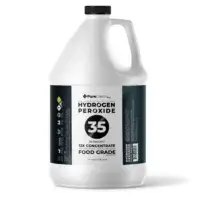 35%Hydrogen peroxide
- About 2.5 gallons per 10,000 gal to reach 100 ppm
- Fewer bottles to buy, carry and store
- More concentrated, so it needs more care when pouring
 12%Hydrogen peroxide
- About 8 gallons per 10,000 gal to reach 100 ppm
- About three times as many bottles
- Less concentrated, but still needs goggles and gloves
Both reach the same ppm in your pool; the difference is how much you carry, pour and store. Check each product page for shipping options, since container size and concentration affect how it ships.
Handling and Storage
Protect eyes & skin
Wear splash-proof goggles and chemical-resistant gloves whenever you handle concentrated peroxide.
Original container
Tightly closed and upright, in a cool, dark, ventilated place out of direct sun.
Store it separately
Away from pool chlorine, bromine, acids, metals and anything flammable.
No pouring back
Never return unused peroxide to the bottle, and never use metal buckets or scoops.
Lock it up
Keep it away from children and pets.
If it splashes
Eyes: rinse with clean water for at least 15 minutes and get medical help. Skin: rinse thoroughly. Follow the SDS first-aid section.
Frequently Asked Questions
How much 35% hydrogen peroxide do I need for my pool?
About 2.5 gallons per 10,000 gallons of water to go from 0 to 100 ppm, or about 2 gallons to reach 80 ppm. Use the calculator for your exact pool size and current reading.
How much 12% hydrogen peroxide do I need?
About 8 gallons per 10,000 gallons of water to go from 0 to 100 ppm, or about 6.4 gallons to reach 80 ppm.
Can I use 3% hydrogen peroxide from the store?
It would take about 33 gallons per 10,000 gallons of pool water to reach 100 ppm, so it isn’t practical for a pool.
What if there is still chlorine or bromine in the pool?
They compete with hydrogen peroxide and use it up, so some of the peroxide you add goes into reacting with them instead of raising your reading. You may need more than the calculator shows. Add in stages and retest until the strip holds in the 50–100 ppm range, and stop adding chlorine or bromine products.
My test strip didn’t change color right after I added peroxide. Why?
A strip dipped into concentrated peroxide, or into the spot where you just poured, gets overloaded and burns out, showing no color at all. Let the pump circulate for several hours, then test from elbow depth away from the return jets.
Why does my reading keep dropping?
Hydrogen peroxide naturally breaks down into water and oxygen. Heat, sunlight, swimmers and debris all speed that up, which is why regular testing and topping up are part of the routine.
What if my reading is over 100 ppm?
Stop adding peroxide and keep the pump running. The level comes down on its own as the peroxide breaks down. Retest each day and resume small additions once the reading falls below your target.
Can I add peroxide while people are swimming?
No. Keep everyone out while you add it, and until the water has circulated and a test strip reads within 50–100 ppm.
Is the calculator exact?
The chemistry is exact, but pool volumes from measurements are estimates and strips read in steps. That’s why the calculator has you add about three quarters first, then retest and top up.
Free PDF guide
Take the pool peroxide guide with you
- Dose charts, 5,000–50,000 gal
- Test strip guide
- Printable pool log
9 pages · sent straight to your inbox
Check your inbox
We sent a download link to . It can take a minute to arrive. Don't see it? Check your spam or promotions folder.
Disclaimer
Information only, used at your own risk. This page, the dose chart and the calculator are general information provided for convenience. They are not professional, engineering, medical or legal advice. Results are estimates that depend on the measurements, test readings and other information you enter, and on conditions we cannot see or control. You are solely responsible for deciding whether and how to use hydrogen peroxide in your pool, and for every amount you add.
No claims about water treatment. This guide explains how to reach and hold a hydrogen peroxide concentration. It makes no claim that hydrogen peroxide sanitizes or disinfects water or controls any organism, and our products are not sold as registered pool sanitizers. Public and commercial pools must follow the requirements of their local health authority.
Equipment, surfaces and property. Hydrogen peroxide is a strong oxidizer. Before use, confirm compatibility with the manufacturers of your pool, liner, plaster, pump, filter, heater, covers and any other equipment. We are not responsible for damage to pools, equipment, surfaces, finishes, decks, clothing, landscaping or any other property, or for voided warranties, resulting from the use or misuse of hydrogen peroxide or of the information on this page.
Skin sensitivity. Some customers with sensitive skin have told us they notice a slight tingling at levels around 120 ppm and above. This is customer feedback, not a tested threshold, and sensitivity varies from person to person. If anyone feels irritation, have them leave the pool and rinse with fresh water, keep everyone out until the level comes down, and seek medical advice if irritation continues.
Handling. Concentrated hydrogen peroxide can cause serious burns to skin and eyes. Always follow the product label and Safety Data Sheet, wear protective equipment, and keep it away from children and pets.
Limitation of liability. To the fullest extent permitted by law, Bulk Peroxide and its owners, employees and affiliates disclaim all warranties, express or implied, regarding this information, and are not liable for any direct, indirect, incidental, consequential or other damages, including personal injury, property damage or loss, arising from the use of this page, the calculator, or our products in a pool. By using this information you accept these terms. Nothing here limits any rights you have that cannot be limited under applicable law.