
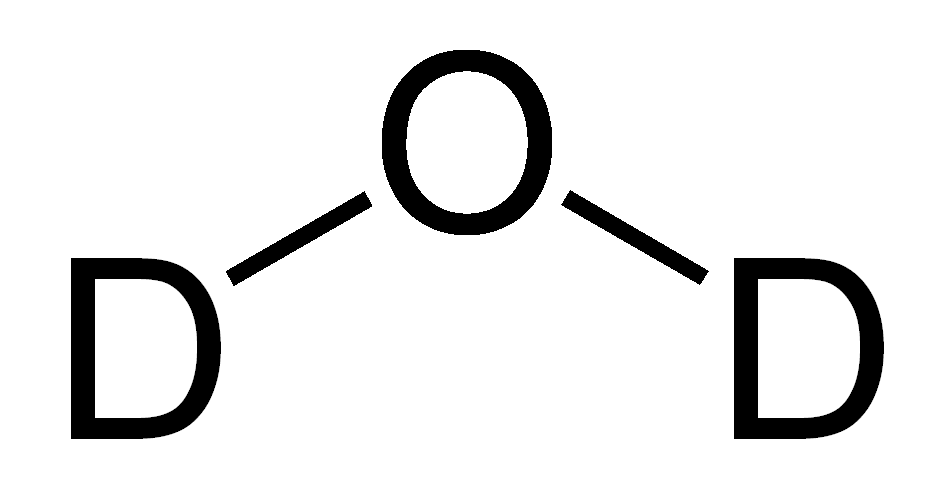
No. Hydrogen peroxide is not heavy water. Hydrogen peroxide is H2O2, with two oxygen atoms in each molecule. Heavy water contains an unusually large share of deuterium, a heavier form of hydrogen. Its familiar formula is D2O, with just one oxygen atom per molecule.
Featured diagram: D means deuterium, a hydrogen isotope. Diagram by Kronf, based on Benjah-bmm27, public domain, via Wikimedia Commons.
The names can be confusing because both substances contain hydrogen and oxygen. But “heavy water” is a specific chemistry term, not a nickname for any liquid that weighs more than water. The difference is easier to see by reading the formulas.
H2O, D2O and H2O2: what changes?
H–O–H
Two hydrogen atoms.
One oxygen atom.
D–O–D
Two deuterium atoms.
One oxygen atom.
H–O–O–H
Two hydrogen atoms.
Two oxygen atoms.
The small numbers in a formula count atoms. No number after O means one oxygen atom. The final “2” in H2O2 means two. NIST lists separate records for water, deuterium oxide and hydrogen peroxide.
Adding an oxygen atom to the formula is not the same change as using a heavier hydrogen isotope. That is the key distinction behind the names.
What does the D in heavy water mean?
D stands for deuterium, also written as hydrogen-2 or 2H. An isotope is a version of an element with the same number of protons but a different number of neutrons. Protons and neutrons are particles in the atom’s central nucleus.
Common hydrogen-1 nucleus: 1 proton + 0 neutrons
Deuterium nucleus: 1 proton + 1 neutron
The U.S. Department of Energy’s isotope explainer describes this same-protons, different-neutrons distinction. A neutron is not an oxygen atom. So using deuterium does not add oxygen to water.
There is also a useful detail behind the shorthand. IUPAC’s definition of heavy water includes water with a significant share of deuterium as D2O or HDO. HDO has one common hydrogen atom, one deuterium atom and one oxygen atom. Heavy water does not have to mean that every molecule in a sample is D2O.
Does “heavier than water” make peroxide heavy water?
No. Weight and chemical identity answer different questions. A container’s weight depends on how much liquid it holds, its contents and the container itself. “Heavy water” identifies deuterium-containing water, not the result of weighing a bottle.
Even the mass of a molecule does not decide the name. The NIST records above give the following values, rounded here for comparison:
| Substance | Molar mass |
|---|---|
| Water, H2O | 18.02 g/mol |
| Deuterium oxide, D2O | 20.03 g/mol |
| Hydrogen peroxide, H2O2 | 34.01 g/mol |
A mole is a fixed counting amount used in chemistry. These values compare that same amount of each substance. They are not grams per milliliter, and they do not tell you what a gallon of peroxide solution weighs. For that separate question, see our guide to hydrogen peroxide gallon weight.
A peroxide percentage does not change the name
A hydrogen peroxide solution contains H2O2 in water. Changing its concentration does not make “heavy water” another name for it. Likewise, “food grade” describes a product grade, not a deuterium formula.
Use the full chemical name, concentration and product documentation when identifying a bottle. Do not substitute one substance for another because both names mention hydrogen or water. For another common naming mix-up, read whether peroxide and hydrogen peroxide mean the same thing.
The short version: D2O changes which hydrogen isotope is present. H2O2 has a different atom count and connection pattern. Hydrogen peroxide is not heavy water.
