
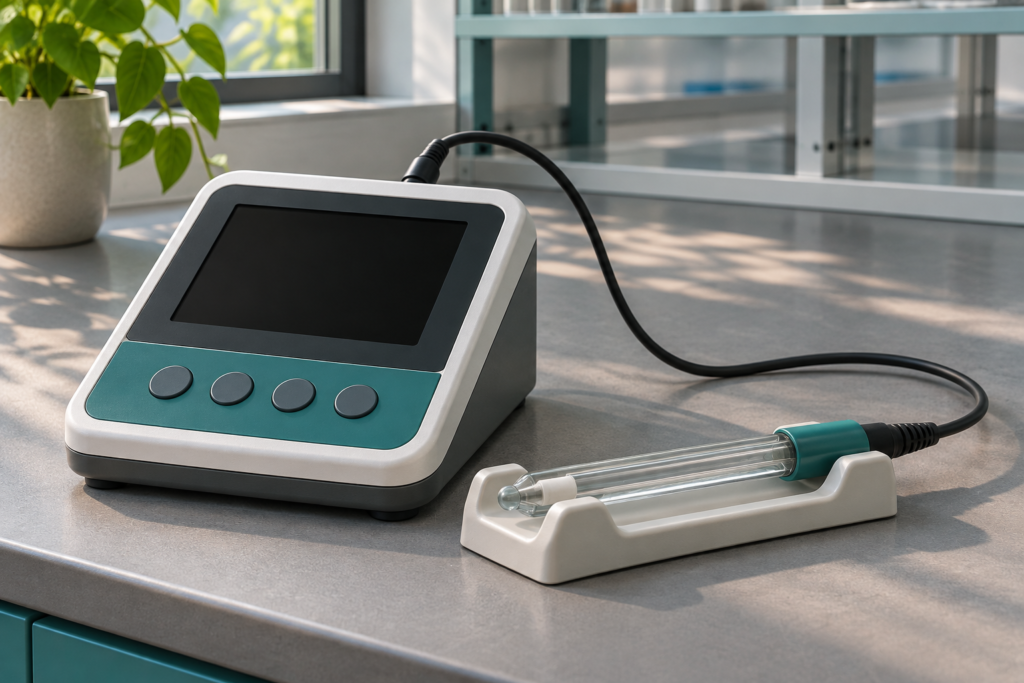
An ordinary ORP meter cannot directly tell you the concentration of hydrogen peroxide. Its reading is an electrical potential in millivolts (mV), not an amount of peroxide in ppm or percent. There is no universal conversion from one to the other.
That matters when a digital display looks more precise than a color strip. A number such as “+450 mV” may look convincing, but the unit tells you it is answering a different question. Before buying a meter to check peroxide strength, make sure it measures the property you actually need.
What does an ORP meter measure?
ORP means oxidation-reduction potential, also called redox potential. It describes the electrical tendency of a solution to accept or donate electrons, measured against a reference electrode. The probe responds to the combined redox conditions in the sample; it does not selectively count hydrogen peroxide molecules.
Hamilton’s ORP explanation distinguishes this combined signal from the concentration of a specific chemical. Peroxide can contribute to that signal, but a voltage alone cannot establish how much peroxide is present.
| Result | What it means | What it does not prove |
|---|---|---|
| ORP in mV | An electrical potential relative to a reference electrode. | The peroxide concentration. |
| Peroxide result in mg/L | Mass of peroxide per volume of sample, measured by the stated method. | That the same result applies to a different sample or bottle. |
| Peroxide assay in % by mass | Peroxide’s share of the total sample mass. | Every other aspect of purity or product suitability. |
When a report uses “ppm,” check its stated basis rather than silently replacing it with mg/L. Our guide to peroxide specifications and COA results explains concentration units and assay results.
Why a higher number does not mean a stronger bottle
ORP depends on more than one ingredient. Changes in pH, temperature and other redox-active substances can affect the reading. The meter’s reference system matters too. Hamilton explains these chemical and temperature effects.
Hypothetical example: two reports show +450 mV and +550 mV for different peroxide-containing samples. Those numbers alone do not show that the second sample contains more peroxide. They certainly do not mean “100 ppm more.” The difference is 100 millivolts, and the samples may differ in other ways.
Even a reading from the same sample can differ when the instrument’s reference electrode or offset setting differs. Apera’s ORP guide explains why the reference and measurement settings belong with the result.
But laboratories use ORP to test peroxide. How?
They can use an ORP electrode as one part of a titration: a controlled analysis that tracks a chemical reaction using a reagent of known concentration. This is different from dipping a meter into a sample and converting the displayed voltage to percent.
Evonik’s peroxide analytical-methods page describes a titration supported by a redox electrode. Vernier’s educational example makes the distinction clear: the reagent volume at the reaction’s equivalence point is used to calculate concentration. The starting ORP number is not the assay.
That is a laboratory-method explanation, not a home testing procedure. Concentrated peroxide requires appropriate equipment and trained handling. Do not improvise sample preparation or put a general-purpose water probe into a concentrated product.
Choose the test for the decision
If you need to check whether a supplied lot met its specification, start with its matching Certificate of Analysis. If you need the current strength of an opened bottle, request a suitable assay; the original certificate cannot establish what happened after its sample was tested.
For a low-level peroxide check, a peroxide-specific strip or instrument may be useful within its stated range and sample limitations. A device that measures ORP is not interchangeable with one that measures peroxide. Our test-strip guide covers range and reading limits without treating a rough result as a precise assay.
ORP can still be useful for watching a process change over time. Apera describes that monitoring role. To make an ORP record useful, keep three things together:
- The sample: where it came from and when it was measured.
- The measurement: mV, instrument, reference electrode and any applied offset.
- The conditions: sample temperature, pH when relevant, and the procedure used.
A process trend and a peroxide concentration are two different results. Keep them separate, and the numbers become much easier to use.
