
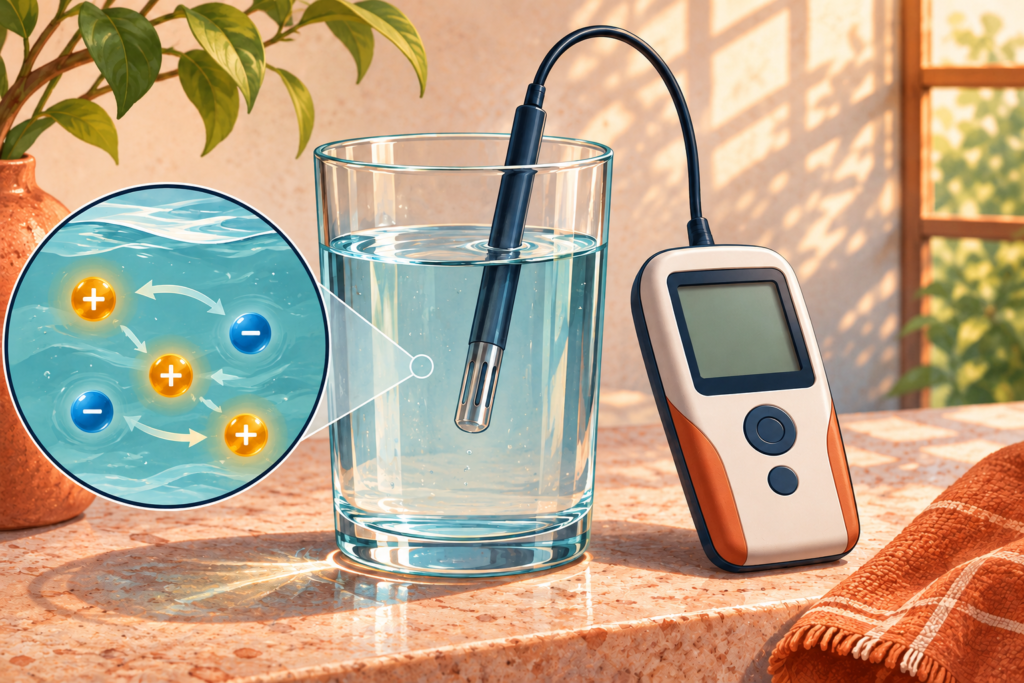
A water conductivity meter measures how readily water carries an electrical current. A conductivity-based TDS meter uses that measurement to estimate total dissolved solids. The numbers are related, but the units, conversion setting and temperature basis matter when you compare them.
That explains a familiar puzzle: two meters can test the same water and show different ppm numbers. Before deciding that the water changed or an instrument failed, check what each meter is actually reporting. Here is how to read the result without asking it to tell you more than it can.
Water conductivity vs. TDS: start with the units
Electrical conductivity, usually shortened to EC, depends on dissolved ions: substances with an electrical charge. Their amounts, types and movement all contribute to the reading. Conductivity does not identify each ion separately. Merck’s water-quality monitoring guide explains the relationship between ions, temperature and conductivity.
| Display | Common units | What it reports |
|---|---|---|
| EC | µS/cm or mS/cm | The water’s electrical conductivity. |
| Estimated TDS | mg/L, often displayed as ppm | An estimate calculated from conductivity using a conversion factor. |
1 mS/cm equals 1,000 µS/cm. A display of 0.10 mS/cm therefore means 100 µS/cm, not 0.10 µS/cm. North Dakota State University’s EC and TDS field guide explains these unit relationships. Keep the full unit beside any number you write down.
TDS is the amount of dissolved material in water. It can include material that contributes little to conductivity, so an electronic estimate is not the same as directly determining the dissolved residue. The water’s composition affects the relationship. Apera’s explanation of conductivity and TDS covers why there is no single conversion factor that fits every water sample.
Why the same water can read 50 ppm or 70 ppm
A conductivity-based meter calculates its TDS result by multiplying EC by a factor. Some instruments have a fixed factor; others let you select one. Hanna describes this calculation in its EC-to-TDS explanation.
Hypothetical example: one conductivity value, two settings
Assume both meters report 100 µS/cm at the same reference temperature.
- With a factor of 0.5: 100 × 0.5 = 50 ppm.
- With a factor of 0.7: 100 × 0.7 = 70 ppm.
The water has not changed in this example. The calculation has. These are illustrative numbers, not test results for a Bulk Peroxide product.
The larger ppm number does not, by itself, mean the second meter detected more material. Equally, neither factor is automatically the correct choice for every sample. Use the factor specified by the measurement method or application. If you are comparing two instruments, start with their EC readings in matching units and then check their TDS settings.
What a zero display can mean
A screen showing “0” or “0.0” cannot prove that a water sample contains no dissolved material. The display has a smallest step, and the instrument has a defined measuring range and accuracy. Those are separate details.
Resolution: the smallest displayed change
A meter that displays whole ppm cannot show every fractional change. More decimal places let you see smaller steps, but the extra digits alone do not establish a more accurate measurement.
Range: where the instrument is designed to work
A broad overall range does not guarantee suitable performance at its very bottom. Check the stated low end and any conditions attached to the specification. For an example of how these details are separated, Vernier’s conductivity probe manual lists range, resolution and accuracy independently. It is an educational instrument, not a recommendation for a commercial process.
Accuracy: how close the result is expected to be
Read the wording after the percentage. “Percent of reading” and “percent of full scale” are different specifications. Full scale refers to the relevant range’s upper value, not simply the number currently on screen. Apera’s full-scale accuracy explanation shows why that distinction matters.
Temperature compensation does not change the water
Conductivity changes with temperature. A temperature-compensated result estimates what the conductivity would be at a chosen reference temperature, commonly 25°C. That reference temperature and the sample’s actual temperature are different pieces of information. A reading reported “at 25°C” does not necessarily mean the water was physically at 25°C.
Automatic temperature compensation, often labeled ATC, is a calculation rather than a heating or cooling function. When comparing results, check whether compensation was enabled and which reference temperature was used. Apera’s conductivity-testing guide explains this reporting convention.
The probe also needs time to settle to the sample temperature. Follow its manual’s stabilization instructions rather than recording the first number that appears. Hanna identifies temperature stabilization and compensation as common sources of conductivity measurement mistakes.
Why a low reading may drift
At low conductivity, small changes in the sample can have a noticeable effect. Residue on the probe, carryover from another sample or contamination from the container can alter what you are measuring. Air exposure matters too: dissolved carbon dioxide can affect the conductivity of low-ion water.
METTLER TOLEDO discusses air exposure and the special care needed for low-conductivity measurements in its conductivity guide, section 3.4. A casual reading from an open cup should not be treated as interchangeable with a controlled measurement from a water system.
For routine checks, use the meter manufacturer’s instructions for calibration, suitable standards, rinsing and sample handling. Keep the method consistent when comparing results over time. A changing number is a reason to review the sample and measurement conditions before deciding what caused it.
What to keep beside a meter reading
A useful record needs enough context for someone else, or your future self, to understand it. Save:
- The sample: which water and when it was checked.
- The result and unit: for example, µS/cm rather than just “EC.”
- The temperature details: actual sample temperature, compensation setting and reference temperature.
- The TDS factor: when reporting a calculated ppm value.
- The instrument and method: meter model, calibration/check status and any relevant handling notes.
This is a practical recording template, not a substitute for a required test method. It helps prevent a unit change or setting change from being mistaken for a change in the water.
Use the reading for the question it can answer
Conductivity is useful for following changes in ionic content under comparable conditions. It does not identify all contaminants or establish complete water purity. Merck’s monitoring guide treats ionic contamination and organic contamination as separate measurement needs.
Processing names answer a different question. Our deionized vs. distilled water guide explains those terms. Bulk Peroxide’s Deionized Distilled Water is available in a one-gallon size; the product name alone should not be converted into an assumed conductivity or TDS specification.
When a job calls for a numerical water-quality limit, compare the required property, units and measurement conditions with documented results. Keep the meter’s number and its context together. That is what makes the reading useful.
