

Hydrogen peroxide is a common household liquid; many of us keep a bottle in the cabinet to fizz on a scraped knee or disinfect a surface.
If you’ve ever wondered how hydrogen peroxide is made, the answer reveals a surprising blend of chemistry and engineering behind this clear liquid that serves healthcare, paper production, and more.
What Hydrogen Peroxide Actually Is
At its core, hydrogen peroxide (H₂O₂) is water with an extra oxygen atom. That single addition makes it reactive and unstable, which explains both its cleaning power and why it breaks down easily into water and oxygen.
This reactivity is what gives hydrogen peroxide its versatility; it disinfects, whitens, deodorizes, and oxidizes without leaving behind toxic residues.
Although small amounts occur naturally in rainwater or even inside living cells, the hydrogen peroxide we use in industries and homes must be made through controlled chemical processes.
Different applications require different levels of concentration, and precision in manufacturing ensures safety and consistency.
A Quick Look Back
Before modern methods, hydrogen peroxide was produced using barium peroxide and acids. It worked, but it wasn’t efficient or clean. Production was expensive and generated unwanted byproducts. The real breakthrough came with the development of the anthraquinone process, a method still used today in nearly every large-scale plant around the world.
This discovery marked a turning point. Instead of producing hydrogen peroxide through single-use chemical reactions, scientists found a way to create it continuously, recycling materials in a loop. It’s a perfect example of how chemistry evolved from slow, manual reactions to highly efficient, industrial systems.
The Anthraquinone Process: The Heart of Modern Production
So, how is hydrogen peroxide made on a large scale? The anthraquinone process is the answer, and it’s as clever as it is efficient.
Here’s how it unfolds step by step.
- Hydrogenation
A compound called anthraquinone is dissolved in an organic solvent. Hydrogen gas is added under pressure with a catalyst such as palladium. This reaction converts anthraquinone into anthrahydroquinone. - Oxidation
The solution is then exposed to oxygen or air. The anthrahydroquinone reacts with the oxygen to form hydrogen peroxide, returning to its original anthraquinone state in the process. This is what makes the cycle renewable; the same compound can be reused again and again. - Extraction
The hydrogen peroxide produced is extracted from the solvent and transferred into water, separating it from the organic medium. - Purification and Concentration
Finally, the solution goes through several purification steps, including distillation or ion-exchange treatment, to remove impurities. It’s then concentrated to the desired level, typically between 30% and 70% for industrial use.
Because the materials in this cycle can be reused, the anthraquinone process is highly efficient and environmentally manageable. It’s a remarkable example of smart chemical design.
Why Manufacturers Don’t Simply Mix Hydrogen and Oxygen
At first glance, combining hydrogen and oxygen to produce hydrogen peroxide sounds logical. In practice, though, it’s extremely risky. The reaction tends to produce water instead, or worse, explosions.
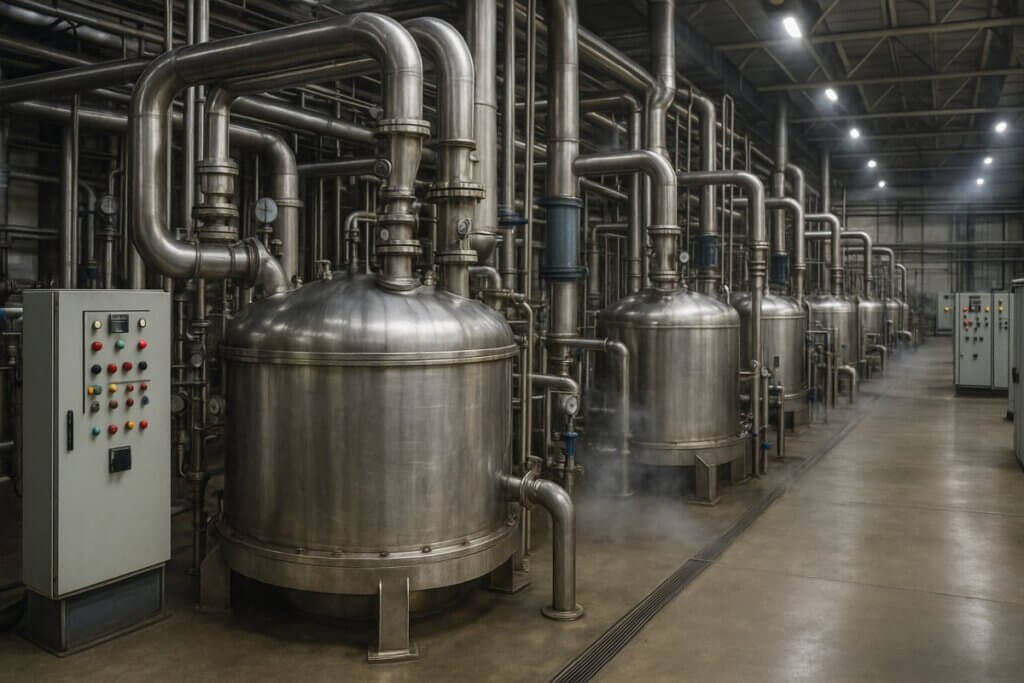
Chemists have experimented for decades to find a safe way to directly synthesize hydrogen peroxide from these gases. Progress has been made, but large-scale production still relies on the anthraquinone method.
Researchers continue to explore catalysts and reactor designs that could make direct synthesis both safe and economical, potentially cutting energy costs and eliminating solvent use in the future.
Catalysts and Stability: Keeping Things Under Control
Catalysts like palladium are the backbone of the process. They help the reaction happen faster and under controlled conditions without being consumed themselves. Over time, these catalysts can lose activity and need to be refreshed or replaced.
Another challenge is stability. Hydrogen peroxide can break down quickly if exposed to heat, light, or trace metals. That’s why plants use corrosion-resistant materials like stainless steel and aluminum for their reactors. Even a small amount of contamination can cause decomposition, which not only reduces yield but can also be dangerous.
Still, this instability is what makes hydrogen peroxide useful; it decomposes into harmless water and oxygen after doing its job.
Different Grades for Different Jobs
Hydrogen peroxide isn’t a one-size-fits-all product. Its strength varies depending on how it’s used:
- 3% Hydrogen Peroxide – The familiar household solution used for first aid and cleaning.
- 6% – 12% Hydrogen Peroxide – Common in hair dye and cosmetic applications.
- 35% Hydrogen Peroxide – Used in food processing and sanitation, often referred to as “food-grade.”
- 50% and above – Industrial concentrations used in textile bleaching, chemical production, and wastewater treatment.
- Over 90% – Specialty applications such as rocket fuel oxidizers.
Each concentration requires special handling and storage. The higher the percentage, the more controlled the environment needs to be to prevent accidents or decomposition.
Environmental Benefits
Despite being a strong oxidizer, the use of hydrogen peroxide in manufacturing processes is considered one of the cleanest chemical practices in industry. It naturally breaks down into water and oxygen without releasing pollutants. This makes it a preferred choice for industries moving away from chlorine-based products.
Modern plants are also designed with recycling and energy efficiency in mind. Solvents used in the anthraquinone process are continuously reused, and some manufacturers are experimenting with renewable hydrogen sources. A few even integrate hydrogen peroxide production with hydrogen generation facilities, minimizing transport risks and emissions.
Everyday and Industrial Uses
Hydrogen peroxide quietly supports dozens of industries and everyday products. As a powerful bleaching agent, it’s used to whiten textiles, bleach paper, sterilize medical tools, and treat clean drinking water systems.
It helps purify wastewater, prepare electronic components, and even plays a role in environmental cleanup by breaking down organic pollutants in soil and groundwater.
The healthcare field relies heavily on it too, especially in sterilization and disinfection. Hospitals use it in vapor form to sanitize rooms and equipment without harmful residues. Its versatility makes it one of the most useful and adaptable chemicals ever produced.
The Push Toward New Methods
While the anthraquinone process continues to dominate, new ideas are taking shape. Scientists are testing electrochemical and photocatalytic systems that could allow smaller, localized hydrogen peroxide production units.
Imagine compact systems capable of producing peroxide on-site for hospitals or food plants, eliminating the need for long-distance shipping or bulk storage.
There’s also a growing push to make hydrogen peroxide production more sustainable. Using renewable hydrogen, green solvents, or entirely solvent-free reactions could reshape how this chemical fits into a low-carbon economy.
So, How Is Hydrogen Peroxide Made?
At its simplest, hydrogen peroxide is made by transferring hydrogen to oxygen through a catalytic loop, the anthraquinone process. But that simple explanation hides a world of engineering precision and chemical insight.
The combination of hydrogenation, oxidation, extraction, and purification forms a continuous cycle that produces a remarkably pure and stable product.
It’s a rare case where science and practicality align perfectly: efficient production, minimal waste, and clean decomposition.
Clean Chemistry in Motion – Powered by PureChemPros
The journey from raw elements to bottled hydrogen peroxide is more sophisticated than it looks. What began as a laboratory curiosity evolved into a global industry built on recycling, precision, and safety.
And while new technologies are emerging, the foundation remains the same, a blend of chemistry and innovation.
If you’re looking for reliable supply and consistent quality, PureChemPros offers high-grade hydrogen peroxide for commercial and industrial use. Contact us today and take the next step toward cleaner, safer, and more efficient production!
