
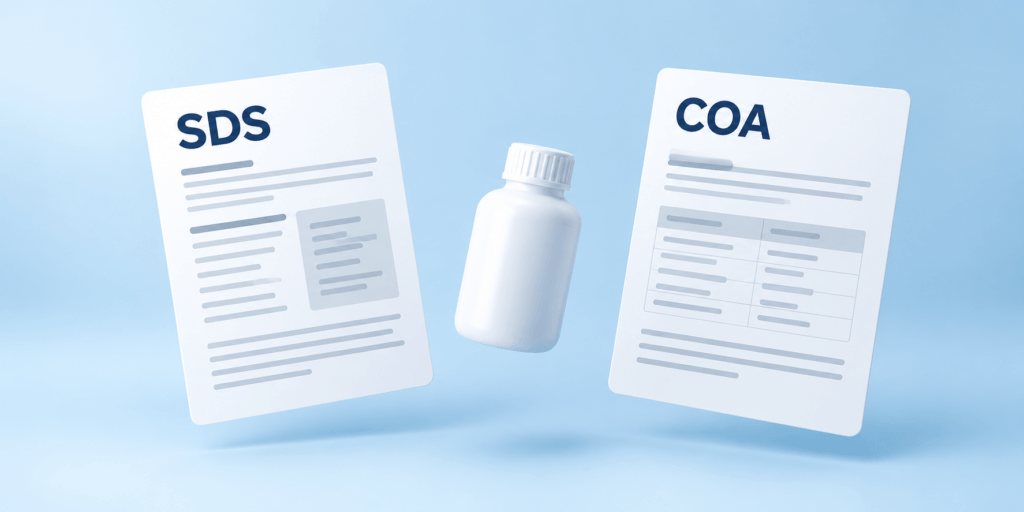
An SDS tells you how to work safely with a hydrogen peroxide product. A COA tells you what the supplier reports about a particular batch. If you need storage precautions, open the SDS. If you need to check the batch’s reported concentration, open its COA.
The names sound similar, and both documents may arrive with the same order. Their jobs are different. Knowing which one to reach for saves you from searching a safety sheet for a test result it was never meant to provide.
Which document do you need?
| Your question | Start here | Look for |
|---|---|---|
| What are the hazards and precautions? | Safety Data Sheet (SDS) | Hazards, handling, storage and protective equipment |
| What concentration was reported for this batch? | Certificate of Analysis (COA) | Lot number, assay and result |
| Does this batch meet a specified impurity limit? | COA plus the applicable specification | The named test, limit, result and units |
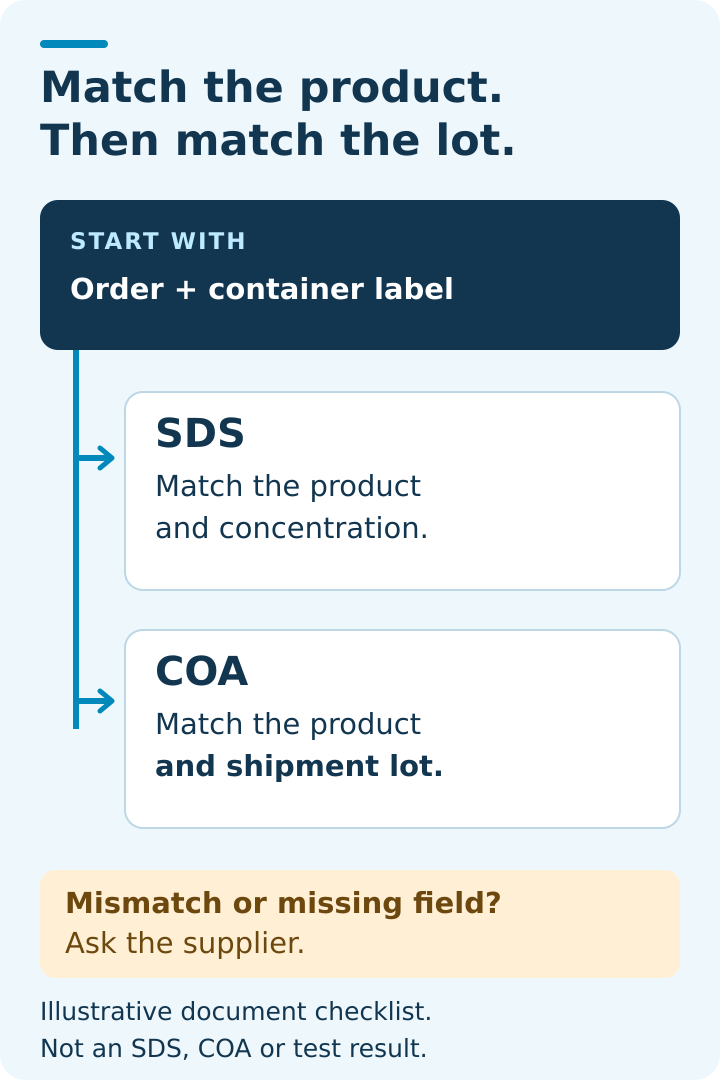
| Is this paperwork for the material I received? | Both, alongside the label | Product identity; the COA also needs the correct lot |
OSHA describes the SDS as a standardized, 16-section source of hazard and protective information. A COA has a different layout: its useful core is the product and lot identity followed by the tests and results. See OSHA’s SDS overview and the representative COA on our site.
Finding an answer in the SDS
You do not have to hunt through every page to locate a section. Start with section 1 to confirm the product, then use the section headings:
- Section 2: hazards and label information.
- Sections 7 and 8: handling, storage and personal protection.
- Section 10: stability, conditions to avoid and incompatible materials.
- Section 16: preparation or revision date.
That is a navigation aid, not a replacement for reading the full applicable sheet before handling the product. A search result for “hydrogen peroxide SDS” can describe a different strength or formulation. Match the supplier and product identifier, not just the chemical name. Our label guide explains how the bottle’s warnings connect with the SDS.
Finding an answer in the COA
Start at the top, before looking at the numbers. A certificate is useful only when you know which product and lot it covers.
For example: if your container has lot EXAMPLE-A and the certificate names EXAMPLE-B, the certificate does not establish your batch’s results. The supplier may have a cross-reference between its own lot code and the manufacturer’s code. Get that connection explained rather than assuming the two codes are interchangeable. These are hypothetical lot names.
Once the lot matches, read across the relevant test row. “Assay” usually refers to hydrogen peroxide content. Other rows may report named impurities, appearance or residue. A specification is the requirement; the result is what the certificate reports. Our guide to reading COA results walks through percentages, limits and “less than” entries.
Why a sample certificate is not your batch certificate
A representative COA lets you see the report’s format and the tests it lists before you buy. It cannot tell you the results for a later shipment. For that, you need the certificate connected to the supplied lot.
The same distinction applies to dates. An issue date tells you when the document was issued. A test date, retest date and expiration date each have their own meaning. Keep the labels attached to the dates instead of treating every date as a shelf-life statement.
Documents available from Bulk Peroxide
- Hydrogen peroxide SDS (PDF), identified in the document as 34.5% food grade.
- Representative COA (PDF), covering the lot named on that certificate.
For documents tied to your order, send us the order number, product name and container lot code. Say whether you need the safety sheet or the batch certificate. If a particular test matters to your purchasing requirements, name it in the request.
The simple distinction: use the SDS for the product’s hazards and precautions, and the matching COA for its reported batch results. Keep both with your order records so the next person does not have to reconstruct the connection.
