
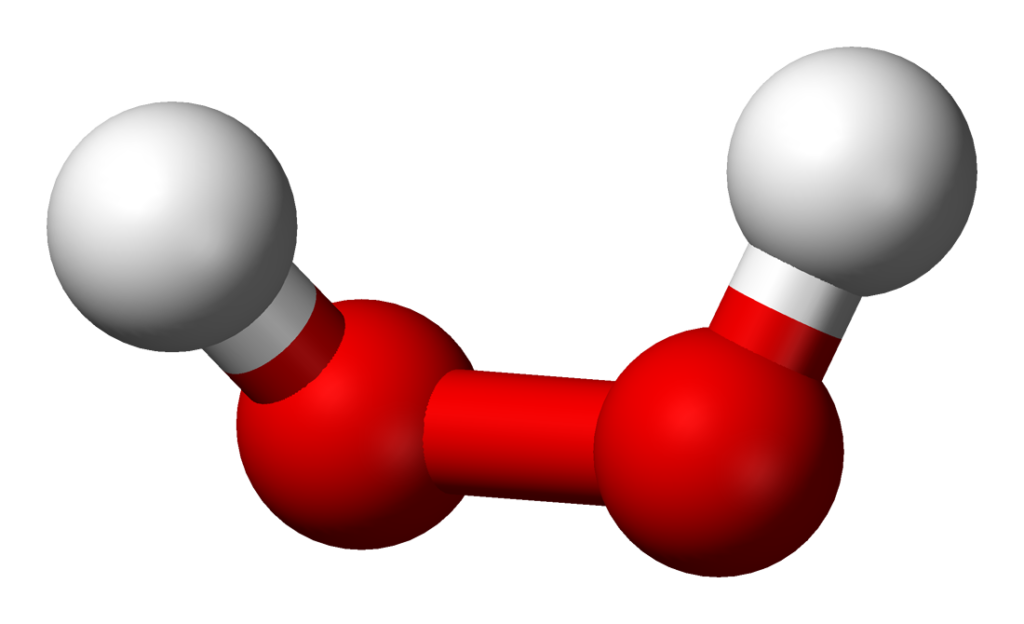
Featured model: one H₂O₂ molecule. Red represents oxygen and white represents hydrogen. The sticks are covalent bonds, not hydrogen bonds between molecules. Model by Benjah-bmm27, public domain, via Wikimedia Commons.
Yes, hydrogen peroxide can form hydrogen bonds. Its oxygen–hydrogen groups can take part in attractions with nearby molecules, including water. These attractions are different from the covalent bonds that join the atoms inside each H₂O₂ molecule.
The similar names make this easy to mix up. An O–H bond contains hydrogen, but chemists do not call every bond involving hydrogen a “hydrogen bond.” The key is to ask which atoms are connected and whether you are looking inside one molecule or between neighbors.
Inside one molecule, the bonds are covalent
Hydrogen peroxide’s atoms connect in the order H–O–O–H. There are two O–H single bonds and one O–O single bond. Each is a covalent bond, meaning that the connected atoms share electrons. This written chain shows connections, not the molecule’s exact three-dimensional shape.
By contrast, an intermolecular hydrogen bond links a suitable hydrogen on one molecule with an electron-rich site on another. “Intermolecular” simply means between molecules. Chemguide’s hydrogen-bonding tutorial explains this distinction using water molecules.
| Connection | What it describes here |
|---|---|
| Covalent O–H or O–O bond | Atoms joined inside one H₂O₂ molecule. |
| Hydrogen bond | An attraction involving an O–H hydrogen and an oxygen on a neighboring molecule. |
Within peroxide: H–O–O–H
One interaction between molecules: O–H ··· O
Why hydrogen peroxide can play both roles
Oxygen attracts the electrons in an O–H bond more strongly than hydrogen does. That leaves the hydrogen partly positive. Oxygen also has lone pairs: pairs of electrons that are not used in the molecule’s ordinary covalent bonds.
Those features let H₂O₂ participate in two ways:
- Hydrogen-bond donor: an O–H group supplies the hydrogen involved in the attraction.
- Hydrogen-bond acceptor: an oxygen’s lone pair provides the electron-rich site involved in the attraction.
“Donor” describes a role in this interaction; it does not mean the molecule must release its hydrogen. PubChem’s hydrogen peroxide record lists two hydrogen-bond donor sites and two acceptor sites. Research on hydrogen peroxide in molecular crystals also documents both roles.
Can it hydrogen-bond with water?
Yes. Water has O–H groups and oxygen lone pairs, too. A hydrogen on peroxide can interact with an oxygen on water, as the connection sketch shows. The roles can also reverse: water can supply the hydrogen and peroxide can supply the accepting oxygen.
A 2022 study of water around hydrogen peroxide describes peroxide acting as both a donor and an acceptor with surrounding water molecules. This is a picture of molecular interactions, not a recommendation to mix products.
How many hydrogen bonds does one molecule form?
There is no single count that describes every setting. The two donor sites and two acceptor sites in a chemical database describe features of the molecule. They do not mean every H₂O₂ molecule always has exactly four hydrogen bonds attached to it.
The available neighbors and their arrangement matter. In the crystal study, peroxide’s accepting interactions varied with the surrounding compounds. A drawing that shows one dotted connection is usually illustrating one interaction, not counting every possible neighbor.
A quick way to read a bonding diagram
- Find each molecule. Follow the solid covalent connections to see which atoms belong together.
- Read the key. In the connection sketch above, dots mark a hydrogen bond between molecules. Other diagrams may use marks differently.
- Check the endpoints. Here, the dotted connection runs from an O–H hydrogen to a neighboring oxygen.
If you are working on a different chemistry question, our guides to oxygen’s oxidation number in H₂O₂ and the meaning of “peroxide” cover those separately.
Keep this picture in mind: covalent bonds hold each H₂O₂ molecule together, while hydrogen bonds help describe how it interacts with suitable neighbors.
