
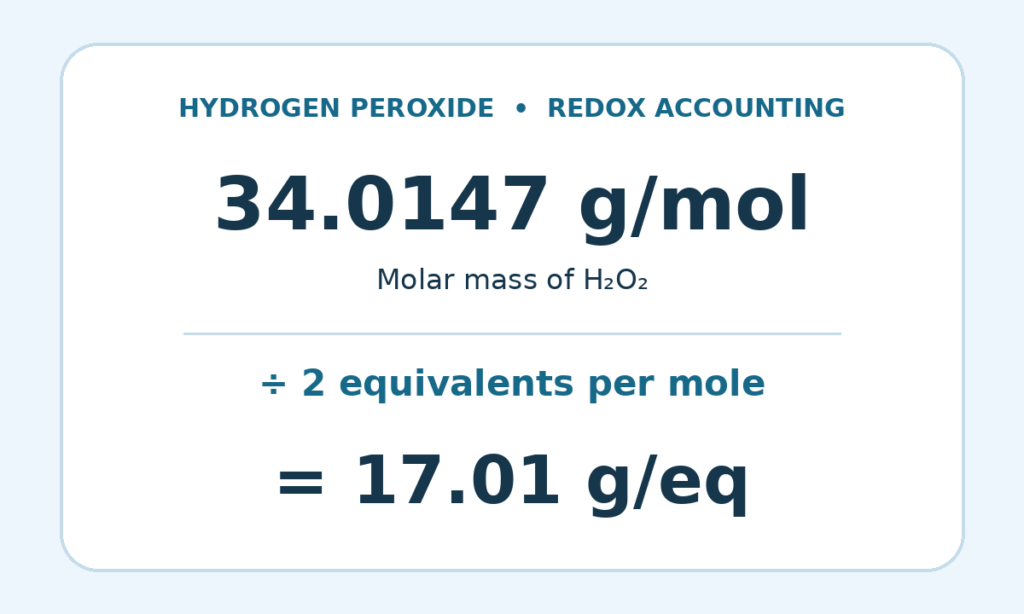
The equivalent weight of hydrogen peroxide (H2O2) is about 17.01 grams per equivalent (g/eq) in a two-electron redox reaction. Its molar mass is about 34.01 grams per mole. Divide that by two because one mole of hydrogen peroxide accounts for two moles of electrons in the reactions below.
What does equivalent weight mean?
A mole counts a fixed number of molecules. An equivalent counts how much chemical change those molecules can account for in a particular reaction. In a redox reaction, that change is measured by electrons gained or lost. One equivalent corresponds to one mole of electrons transferred. The IUPAC recommendations on equivalents tie that definition to a specified reaction. Equivalent weight is a mass, even though the older name uses the word “weight.”
Why do you divide 34.01 by two?
- Find the molar mass. The NIST Chemistry WebBook lists 34.0147 for H2O2, which corresponds to a molar mass of 34.0147 g/mol.
- Count the electrons per molecule in the stated half-reaction. For hydrogen peroxide reduced to water or oxidized to oxygen gas, the number is two. Textbooks often call that number the n-factor.
- Divide the molar mass by the number of equivalents per mole. 34.0147 g/mol ÷ 2 eq/mol = 17.00735 g/eq, or 17.01 g/eq rounded to two decimal places.
If your textbook uses 34 g/mol for the molar mass, the rounded answer is 17 g/eq. It is the same calculation, not a different result.
How can hydrogen peroxide gain or lose two electrons?
Hydrogen peroxide has two oxygen atoms with an oxidation number of −1 each. In water, oxygen is −2. In oxygen gas, it is 0. So each oxygen can move one step down or one step up, depending on the reaction. Two oxygen atoms changing by one step each account for two electrons.
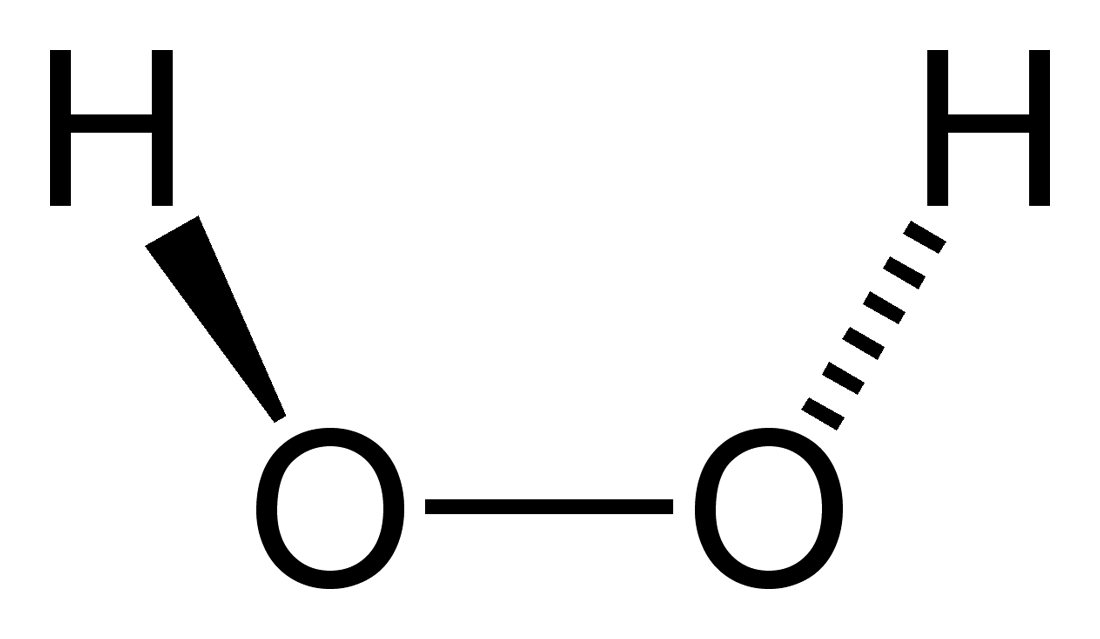
Purdue University’s chemistry example shows both of these half-reactions. A half-reaction writes out just the gain or the loss of electrons. These are equations for electron accounting, not instructions for carrying out a reaction.
- Reduced to water (acts as an oxidizing agent)
- H2O2 + 2 H+ + 2 e− → 2 H2O. The electrons are on the left because hydrogen peroxide gains them.
- Oxidized to oxygen gas (acts as a reducing agent)
- H2O2 → O2 + 2 H+ + 2 e−. The electrons are on the right because hydrogen peroxide loses them.
The equivalent weight is the same for these two cases because the number of electrons is the same. Only the direction changes.
Molar mass, equivalent weight and bottle percentage
- Molar mass: About 34.01 g per mole of H2O2. It comes from the molecule’s formula.
- Equivalent weight: About 17.01 g of H2O2 per equivalent for the two-electron reactions above. It comes from the formula and the reaction.
- Percent by mass: Grams of hydrogen peroxide per 100 grams of total solution. It describes what is in a bottle, not how many electrons a molecule gains or loses. The guide to reading hydrogen peroxide specifications explains this label unit.
For a textbook problem, look at the half-reaction first. If it transfers two electrons for one molecule of H2O2, use about 17.01 g/eq. The number 17.01 is not a percentage or a measure of product strength.
