


Hydrogen Peroxide Test Strips
$29.99 Original price was: $29.99.$19.99Current price is: $19.99. — or subscribe to save 5%
Color blocks at 0, 1, 3, 10, 30 and 100 ppm. Dip straight into pool, hot tub, plunge, fountain or reservoir water. Testing a 3%, 6%, 12% or 35% bottle? Dilute a small sample first — the calculator below shows exactly how.
Never dip a strip straight into 3%, 6%, 12% or 35%
These strips measure tiny amounts: 0 to 100 parts per million (ppm). Store-bought 3% hydrogen peroxide is about 30,000 ppm, and 35% is close to 400,000 ppm. Dip a strip straight into any bottle and the pad is overloaded, so it can show the wrong color or no color at all.
How the color chart works
The pad turns from white to deeper blue as the level rises. Match it to the chart printed on the bottle.
Illustration only. Always compare against the chart on your bottle.
Test strip calculator
Pick what you’re testing. For a bottle or a homemade mix, it gives you a step-by-step dilution and turns your strip reading back into a strength.
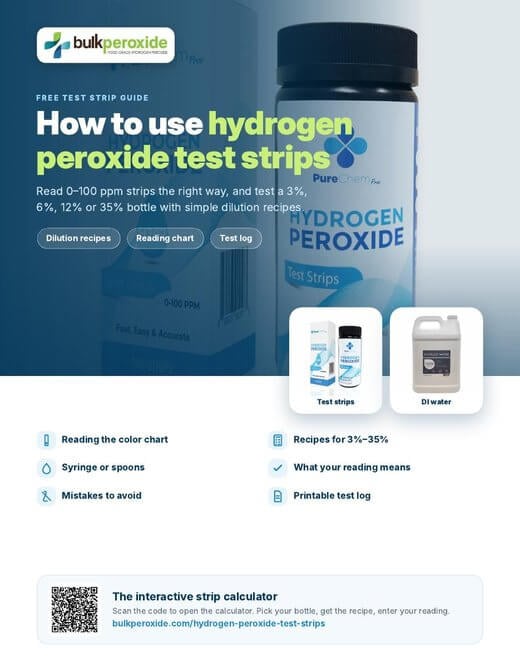
Free PDF guide
Take the test strip guide with you
- Dilution recipes for 3%–35%
- What each reading means
- Printable test log
5 pages · by email (and text, if you like)
Check your inbox
We sent a download link to . It can take a minute to arrive. Don't see the email? Check your spam or promotions folder.
How to read a test strip
- Take out one strip and close the cap right away. Moisture in the air ruins the strips left in the bottle. Hold it by the plain end and keep dry fingers off the pad.
- Dip the pad for 1 second. In pool, tub or reservoir water, dip a few inches down, away from the jets and from where you last poured. For a bottle or homemade mix, dip into your final diluted mix.
- Shake off the extra water once. Don’t wipe or blot the pad.
- Wait 15 seconds. Then read it right away. Colors can keep changing after that.
- Match it to the chart in good light. Daylight is best. Between two colors? Note both. The calculator works with “between” readings.
What you need to test a bottle
Quick dilution chart for testing a bottle
The same recipes the calculator uses. Always use distilled water, and stir after each step.
With a 1 mL medicine syringe
| Bottle | Step 1: make Mix 1 | Step 2 | Multiply reading by | Full strength reads |
|---|---|---|---|---|
| 3% | 1 mL + water to 1 liter | None — test Mix 1 | × 1,000 | about 30 ppm |
| 6% | 1 mL + water to 1 liter | 10 mL Mix 1 + 10 mL water | × 2,000 | about 31 ppm |
| 12% | 1 mL + water to 1 liter | 10 mL Mix 1 + 30 mL water | × 4,000 | about 31 ppm |
| 35% | 1 mL + water to 1 liter | 10 mL Mix 1 + 120 mL water | × 13,000 | about 30 ppm |
With measuring spoons & cups
| Bottle | Step 1: make Mix 1 | Step 2 | Multiply reading by | Full strength reads |
|---|---|---|---|---|
| 3% | ¼ tsp + 5 cups water | None — test Mix 1 | × 961 | about 31 ppm |
| 6% | ¼ tsp + 5 cups water | 1 tbsp Mix 1 + 1 tbsp water | × 1,922 | about 32 ppm |
| 12% | ¼ tsp + 5 cups water | 1 tbsp Mix 1 + 3 tbsp water | × 3,845 | about 33 ppm |
| 35% | ¼ tsp + 5 cups water | 1 tbsp Mix 1 + 13 tbsp water | × 13,457 | about 29 ppm |
What people test with these strips
Ranges are what owners of each system describe holding. Each guide has its own dose calculator.
Pools, hot tubs & cold plunges
Owners test before adding peroxide and again after it circulates. Dip straight into the water.Hydroponic reservoirs
Growers test the reservoir before and after dosing. Dip straight into the reservoir.Decorative fountains
Check the level before topping up. Dip straight into the basin water.Well tanks
Owners track the level in holding and pressure tanks, at the target their water professional sets.Checking a bottle
Find out whether an older 3%–35% bottle has kept its strength. Use the calculator above.Checking a homemade mix
Make sure a spray bottle, seed soak or other mix came out the strength you meant. Pick “Other” in the calculator.Mistakes to avoid
Storing your strips
Customer reviews
Real Customer Reviews
Customer service
Great product and customer service
Good product
Helps keep my pool in the perfect range. Thanks!
Test Strips
Works great 👍
Great product!
Great product! I used them when i shocked my wells. I was able to tell when the peroxide was at every outlet.
MUST have!
So simple to use, and it seems to be incredibly accurate!!
Works as said
Great
As expected
Does as advertised. Easy to use. Basic results to maintain a swimming pool. If you need more testing precision, get another kit. Arrived in a reasonable amount of time.
Perfect
Easy to use and read!
Great strips!
Easy to use!!
Very Satisfied
Has exceeded my expectations.
Test strip FAQ
Can I dip a strip straight into 3% hydrogen peroxide?
No. 3% is about 30,000 ppm, roughly 300 times the top of the strip. Dilute a sample first: 1 mL in 1 liter of distilled water brings a full-strength 3% bottle to about 30 ppm.
How do I test 35% hydrogen peroxide?
Use two steps. Put 1 mL of 35% in distilled water up to 1 liter (Mix 1). Then mix 1 part Mix 1 with 12 parts distilled water and test. Multiply the reading by 13,000. A full-strength bottle reads about 30 ppm.
How accurate is this?
It’s a quick check, not a lab test. The color blocks are spaced apart, so treat the answer as a range. It’s plenty to tell whether a bottle is close to its label, has lost a lot of strength, or a mix came out wrong.
What do the color blocks mean?
The chart has blocks at 0, 1, 3, 10, 30 and 100 ppm. If your pad falls between two blocks, the level is between those numbers.
How many strips come in a bottle?
100 strips. Each one is single use.
My strip didn’t change color. Why?
Either there’s little or no peroxide, the strip was overloaded by concentrate, or the strips are old or got damp. Test water you know has peroxide in it to check the strips.
Does a reading tell me the water is safe for anything?
No. The strips only measure how much hydrogen peroxide is in the sample. They don’t tell you anything else about the water.
Why distilled water?
Tap water has minerals and other things that can affect peroxide and the reading. Distilled or deionized water keeps the test clean.
Free PDF guide
Take the test strip guide with you
- Dilution recipes for 3%–35%
- What each reading means
- Printable test log
5 pages · by email (and text, if you like)
Check your inbox
We sent a download link to . It can take a minute to arrive. Don't see the email? Check your spam or promotions folder.
Disclaimer
Information only, used at your own risk. This page, its calculator and the PDF share general information about reading hydrogen peroxide test strips and diluting samples to test them. Results are estimates; strip readings are approximate and depend on technique, timing and storage. Follow the instructions supplied with the strips.
No product claims. A strip reading measures hydrogen peroxide concentration only. It does not show that water or any surface, food or other item is clean, safe or suitable for any use.
Handling. Concentrated hydrogen peroxide can cause serious burns to skin and eyes. Wear gloves and eye protection when measuring 12% or 35%, follow the product label and Safety Data Sheet, and keep peroxide and strips away from children and pets.
Limitation of liability. To the fullest extent permitted by law, Bulk Peroxide disclaims all warranties regarding this information and is not liable for any damages arising from its use.